

-
Original Article
-
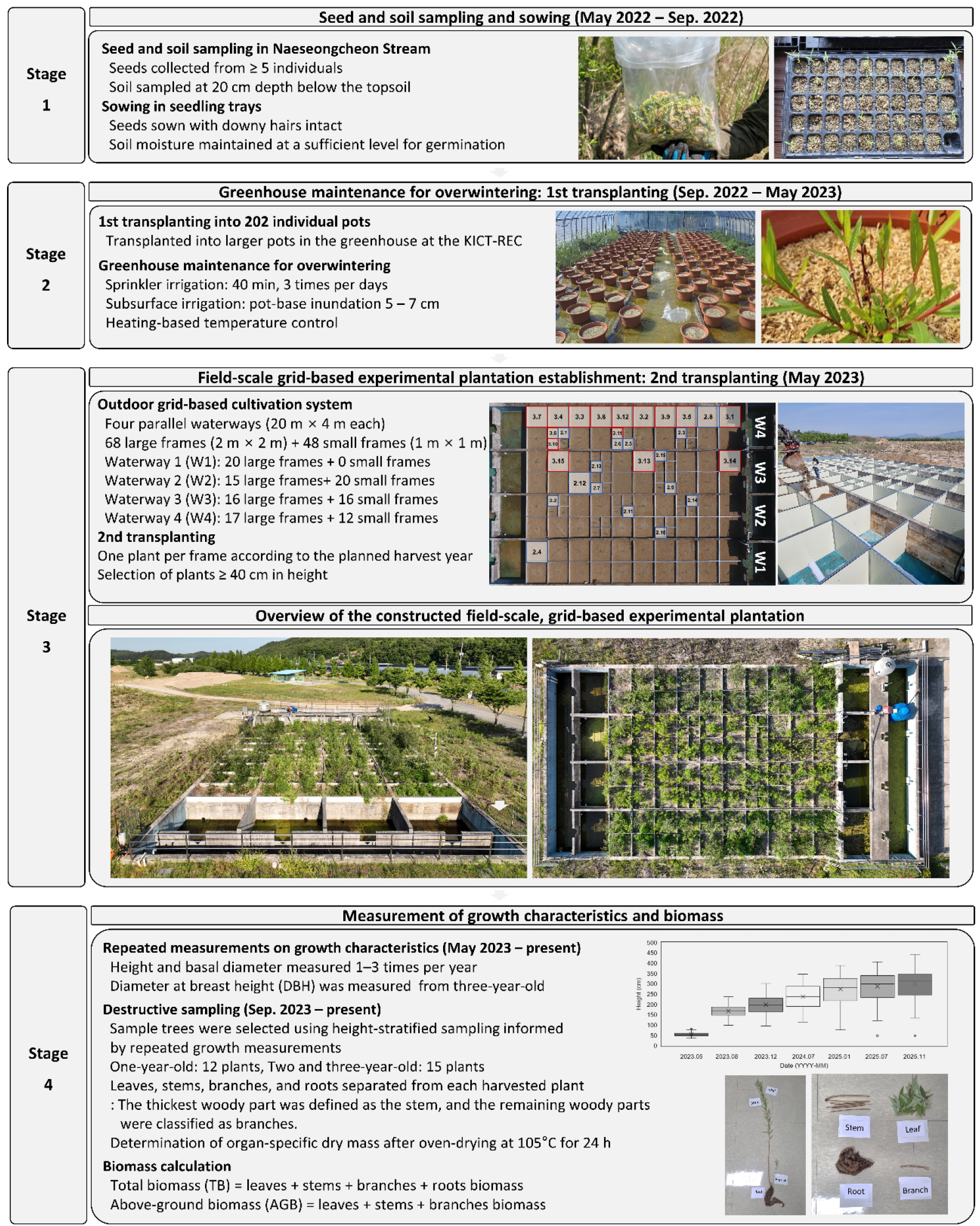
Estimation of Age-dependent Carbon Dioxide Uptake by Salix nipponica based on Destructive Sampling Data from a Grid-based Experimental Plantation Combined with Field Survey Data
격자형 실험 생육장의 직접수확 자료와 현장조사 자료를 기반으로 한 선버들의 수령별 이산화탄소 흡수량 추정
-
Yunchae Park, Jiwon Ryu, Chan-joo Lee, Seonggi An, Eunkyung Jang, Un Ji
박윤채, 류지원, 이찬주, 안성기, 장은경, 지운
- This study quantitatively estimated the age-dependent carbon dioxide uptake of Salix nipponica by establishing a grid-based outdoor experimental plantation and conducting growth …
본 연구에서는 선버들의 수령별 이산화탄소 흡수량을 정량적으로 추정하기 위하여, 격자형 야외 선버들 생육장을 구축하고 1–3년생 선버들을 대상으로 생장 특성 조사와 직접수확 기반 …
- This study quantitatively estimated the age-dependent carbon dioxide uptake of Salix nipponica by establishing a grid-based outdoor experimental plantation and conducting growth measurements and destructive biomass sampling of one- to three-year-old willows. Based on the estimated component biomass, age-based averaged annual production, increment-based production, and carbon dioxide uptake were calculated. The age-based averaged annual total carbon dioxide uptake was 0.3, 3.89, and 7.82 tCO2 ha-1 yr-1in one-, two-, and three-year-old willows, whereas the increment-based total carbon dioxide uptake was 0.3, 6.66, and 13.81 tCO2 ha-1 yr-1, respectively. For two- and three-year-old willows, the increment-based carbon dioxide uptake was higher than the age-based averaged annual carbon dioxide uptake, indicating that uptake estimates may differ depending on the calculation approach when biomass increment is not evenly distributed across ages. Using the individual-tree data, species-specific allometric equations relating basal diameter to organ and whole-plant biomass were derived; basal diameter alone explained 87.2% of the variation in ln-transformed total biomass and in ln-transformed below-ground biomass, providing a non-destructive basis for estimating stand-level early-stage carbon accumulation, although leave-one-out cross-validation showed that individual-level prediction error remains large (MAPE 87.5%), so the equations are intended for stand-level mean estimation. In addition, previous field-survey-based studies of Salix nipponica communities in Korean rivers and riparian zones were reorganized on a common above-ground carbon dioxide uptake basis and compared with the results of this study. The reviewed same-species data with age information showed that above-ground carbon dioxide uptake generally increased with individual growth as age increased, although the increase slowed or decreased in some older stands due to decreasing tree density. This study provides comparable destructive-harvesting-based and field-survey-based data, together with species-specific allometric equations, as baseline information for evaluating riparian carbon sinks.
- COLLAPSE
본 연구에서는 선버들의 수령별 이산화탄소 흡수량을 정량적으로 추정하기 위하여, 격자형 야외 선버들 생육장을 구축하고 1–3년생 선버들을 대상으로 생장 특성 조사와 직접수확 기반 생물량 산정을 수행하였다. 산정된 부위별 생물량을 바탕으로 수령 기반 연평균 생산량, 증가량 기반 생산량 및 이산화탄소 흡수량을 산출하였다. 분석 결과, 수령 기반 연평균 총 이산화탄소 흡수량은 1년생 0.3, 2년생 3.89, 3년생 7.82 tCO2 ha-1 yr-1로 산정되었으며, 증가량 기반 총 이산화탄소 흡수량은 각각 0.3, 6.66, 13.81 tCO2 ha-1 yr-1로 나타났다. 1년생을 제외한 동일 수령에서 증가량 기반 이산화탄소 흡수량은 수령 기반 연평균 이산화탄소 흡수량보다 크게 산정되어, 생물량 증가가 수령별로 균등하게 이루어지지 않을 경우 이산화탄소 흡수량 평가 결과가 달라질 수 있음을 확인하였다. 아울러 개체별 자료를 이용하여 기저직경 기반 부위별 및 총 생물량 상대생장식을 도출하였으며, 기저직경 단일 변수로 로그 변환된 총 생물량 및 지하부 생물량 변동의 87.2%를 설명하여 초기 생장 단계 선버들의 탄소 축적량을 비파괴적으로 추정할 수 있는 근거를 제시하였다. 다만 leave-one-out 교차검증 결과 개체 단위 예측오차(MAPE)는 87.5%로 크게 나타나, 본 상대생장식은 개체별 정밀 예측이 아니라 군락 평균 추정에 적합하다. 또한 국내 하천 및 수변구역의 선버들 군락을 대상으로 수행된 현장조사 기반 선행연구 자료를 지상부 이산화탄소 흡수량 기준으로 재정리하고 본 연구 결과와 비교하였다. 재정리된 자료에서 수령 정보가 제시된 동일 수종 자료를 검토한 결과, 지상부 이산화탄소 흡수량은 수령 증가에 따른 개체 생장과 함께 대체로 증가하였으나 일부 고수령 자료에서는 수목밀도 감소의 영향으로 증가폭이 둔화되거나 감소하는 양상도 나타났다. 본 연구는 직접수확 기반 자료와 현장조사 기반 선행연구 자료, 그리고 종 고유 상대생장식을 비교 가능한 형태로 제시하여 수변구역 탄소 흡수원 평가를 위한 기초자료를 제공하고자 하였다.
-
Estimation of Age-dependent Carbon Dioxide Uptake by Salix nipponica based on Destructive Sampling Data from a Grid-based Experimental Plantation Combined with Field Survey Data
-
Original Article
-
Sensitivity Analysis of Flood Runoff Models according to Watershed Characteristics and Project types in Disaster Impact Assessment
재해영향평가 개발사업과 유역 특성별 홍수유출량 산정 모델의 민감도 분석에 관한 연구
-
Changjae Kwak, Kwangjin Jang, Jungsoo Kim
곽창재, 장광진, 김정수
- This study aims to propose an optimal flood runoff calculation method tailored to the geometric characteristics and types of development projects, addressing …
본 연구는 재해영향평가 협의 시 적용되는 홍수유출량 산정방법의 현행 한계를 극복하고, 개발사업의 유역 특성 및 사업 유형에 적합한 유출모형의 채택 방안을 제안하고자 …
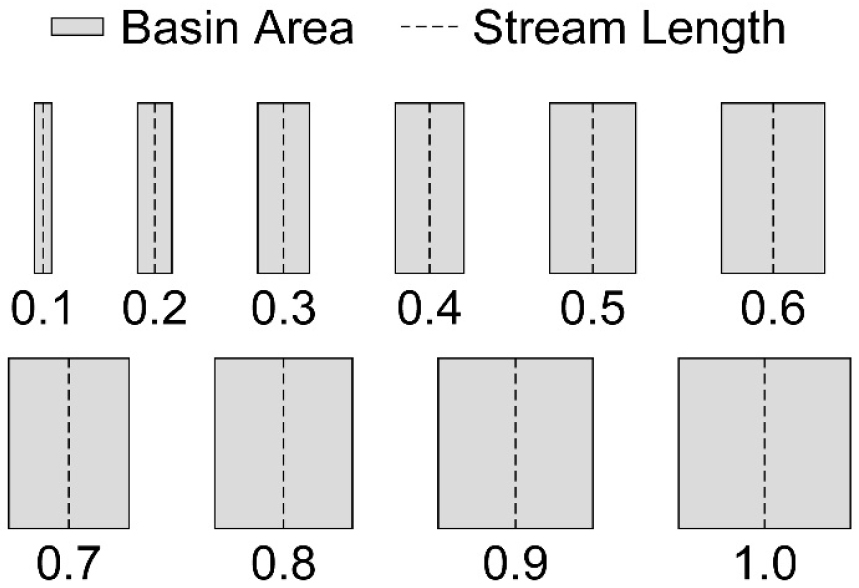
- This study aims to propose an optimal flood runoff calculation method tailored to the geometric characteristics and types of development projects, addressing the limitations of current standards in Disaster Impact Assessment (DIA). Based on 63 years (1961–2023) of hourly rainfall data from the Ulsan Meteorological Station and a 50-year return period rainfall, a sensitivity analysis of key parameters (basin area, shape factor, and channel slope) was conducted across 300 virtual watershed conditions and actual project sites (land development, road construction, and quarry/mountainous development) using four runoff models: the Clark unit hydrograph, Time-Area, Rational Formula, and NRCS unit hydrograph methods. The results revealed that the NRCS method exhibited extremely low parameter sensitivity, while the Time-Area method showed inconsistent trends. The Clark method was sensitive to basin area changes but lacked sensitivity above certain shape factors. Conversely, the Rational Formula displayed the most stable and consistent sensitivity across all parameter variations. In actual project applications, the Rational Formula best reflected structural changes caused by road and mountain developments. However, since the Rational Formula only estimates peak flows and cannot generate hydrographs required for flood retention storage design, this study highlights the necessity of developing a modified rational formula or a specialized runoff model optimized for DIA projects.
- COLLAPSE
본 연구는 재해영향평가 협의 시 적용되는 홍수유출량 산정방법의 현행 한계를 극복하고, 개발사업의 유역 특성 및 사업 유형에 적합한 유출모형의 채택 방안을 제안하고자 수행되었다. 울산관측소의 63개년(1961~2023년) 시우량 자료와 50년 빈도 확률강우량을 바탕으로, 가상유역 300개 모의 조건과 실제 개발사업(택지개발, 도로, 산지개발) 사례에 적용하여 4가지 주요 유출모형(Clark 단위도법, 시간-면적법, 합리식, NRCS 단위도법)의 매개변수(유역면적, 형상계수, 유로경사) 민감도를 비교 분석하였다. 분석 결과, NRCS 모형은 매개변수 변화에 대한 민감도가 매우 낮았고, 시간-면적법은 매개변수 변화에 따른 일정한 경향성을 보이지 않았다. Clark 단위도법은 면적 변화에는 민감하나 특정 형상계수 이상에서는 민감도가 소실되는 한계를 나타냈다. 반면, 합리식은 면적, 형상, 경사 변화 모두에서 가장 일정하고 안정적인 민감도를 나타냈다. 실제 사업 유형별 적용에서도 도로 및 산지개발과 같이 형상계수나 경사 변화가 지배적인 경우 합리식만이 유역 특성 변화를 충실히 반영하였다. 다만 합리식은 수문곡선 및 저류지 용량 산정에 한계가 있으므로, 향후 개발사업의 지형·공학적 특성을 반영할 수 있는 수정합리식 도입 또는 재해영향평가 전용 홍수유출 모형 개발이 필요함을 제안한다.
-
Sensitivity Analysis of Flood Runoff Models according to Watershed Characteristics and Project types in Disaster Impact Assessment
-
Original Article
-
Estimation of Street Inlet Spacing on Roads Using an Improved Intercepted-Flow Equation
개선 차집 유량 산정식을 적용한 도로 빗물받이 설치 간격 산정
-
Jungsoo Kim
김정수
- The current Korean sewer design standard prescribes street inlet spacing only as a broad range of 10–30 m, which may lead to …
현행 하수도설계기준의 빗물받이 설치 간격 규정(10~30 m)은 도로 조건과 설계강우를 반영하지 못하는 포괄적 규정으로서 조건에 따라 과소 또는 과대 설계를 초래할 수 …
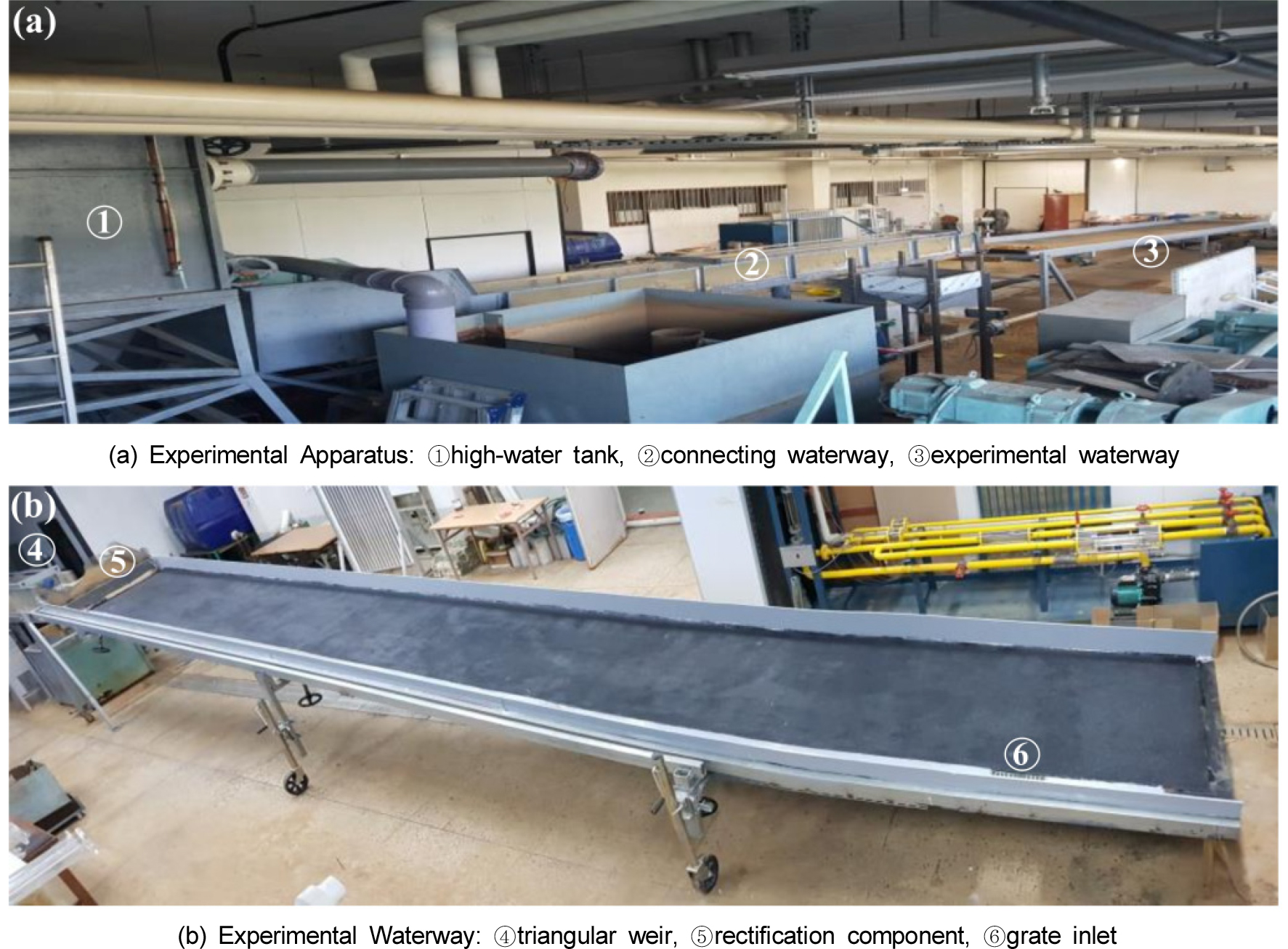
- The current Korean sewer design standard prescribes street inlet spacing only as a broad range of 10–30 m, which may lead to under- or over-design because road geometry and design rainfall are not explicitly considered. This study presents a quantitative method for determining grate inlet spacing on roads by combining an improved intercepted-flow equation, derived by the authors in a previous study from 720 half-scale hydraulic model experiments on Korean standard grate inlets (Kim et al., 2021), with an interception efficiency criterion of 95%. Here, "improved" denotes that the equation reflects the measured interception characteristics of Korean standard grates rather than theoretical formulas calibrated for foreign grate types; accordingly, the contribution of this study lies not in the equation itself but in the spacing algorithm and the design tables that couple the equation with design rainfall and a performance criterion. An iterative spacing algorithm reflecting the upgraded design frequencies of sewer conduits (10 years for lateral and 30 years for trunk sewers) was implemented as a spreadsheet-based GUI program. The program was applied to the Seoul area to produce design spacing values for three inlet sizes (40×50, 40×100, and 40×150 cm), two to four lanes, longitudinal slopes of 2–10%, gutter transverse slopes of 4% or more, and return periods of 5–30 years. The results show that inlet spacing is governed by the transverse slope, inlet size, return period, and number of lanes, in that order; the lower limit (10 m) prevails for small inlets and the upper limit (30 m) for large inlets, confirming the need to refine the current provision according to road conditions. A comparison with the allowable-spread-based framework of HEC-22 highlights the disaster-prevention-oriented nature of the proposed efficiency-based design.
- COLLAPSE
현행 하수도설계기준의 빗물받이 설치 간격 규정(10~30 m)은 도로 조건과 설계강우를 반영하지 못하는 포괄적 규정으로서 조건에 따라 과소 또는 과대 설계를 초래할 수 있다. 본 연구에서는 저자의 선행 연구에서 국내 표준형 쇠살대에 대한 1/2 축척 수리모형 실험(720회)으로부터 도출된 개선 차집 유량 산정식(Kim et al., 2021)과 과 차집효율 95% 성능 기준을 결합하여 도로 조건별 빗물받이 설치 간격을 정량적으로 산정하는 방법을 제시하였다. 상향된 관거 설계빈도(지선 10년, 간선 30년)를 반영한 반복계산 알고리즘을 스프레드시트 기반 GUI 프로그램으로 구현하고, 서울지역에 적용하여 유입부 규격(40×50, 40×100, 40×150 cm), 차선수(2~4차선), 종경사(2~10%), 횡경사(4% 이상) 및 재현기간(5~30년)별 설치 간격 설계값을 제시하였다. 산정 결과 설치 간격은 횡경사, 유입부 규격, 재현기간, 차선수의 순으로 지배되었으며, 소형 유입부는 하한(10 m), 대형 유입부는 상한(30 m)이 지배하는 조건이 광범위하게 나타나 현행 규정의 도로 조건별 세분화 필요성이 확인되었다. 아울러 미국 HEC-22의 허용 침수 폭 기반 체계와의 비교를 통하여 차집효율 기준 설계의 방재 지향적 특성을 제시하였다. 여기서 개선이란 국외 격자 형상의 실험 도표에 근거한 기존 이론식과 달리 국내 표준형 쇠살대의 실측 차집 특성을 반영하였음을 의미하며, 본 연구의 기여는 산정식 자체의 도출이 아니라 이를 설계강우 및 차집 성능 기준과 결합한 설치 간격 산정 알고리즘과 설계표의 정립에 있다.
-
Estimation of Street Inlet Spacing on Roads Using an Improved Intercepted-Flow Equation
-
Original Article
-
Analysis of Flood Runoff Characteristics in Eastern Jeju Island According to the Application of Hydrologic Soil Groups Considering Field Permeability Characteristics
현장 투수특성을 고려한 수문학적 토양군 적용에 따른 제주 동부지역 홍수유출 특성 분석
-
Geun-hyeok Han, Seung-Hyun Kim, Dong-Wook Lee, Myung-Soo Kang
한근혁, 김승현, 이동욱, 강명수
- This study compared the existing Hydrologic Soil Groups (HSGs) with field permeability characteristics in six watersheds in Jeju Island and analyzed changes …
본 연구에서는 제주지역 6개 유역을 대상으로 기존 수문학적 토양군(HSG)과 현장 투수특성을 비교하고, HSG 적용조건에 따른 유출곡선지수(CN) 및 첨두홍수량의 변화를 분석하였다. 기존 토양자료에서는 …
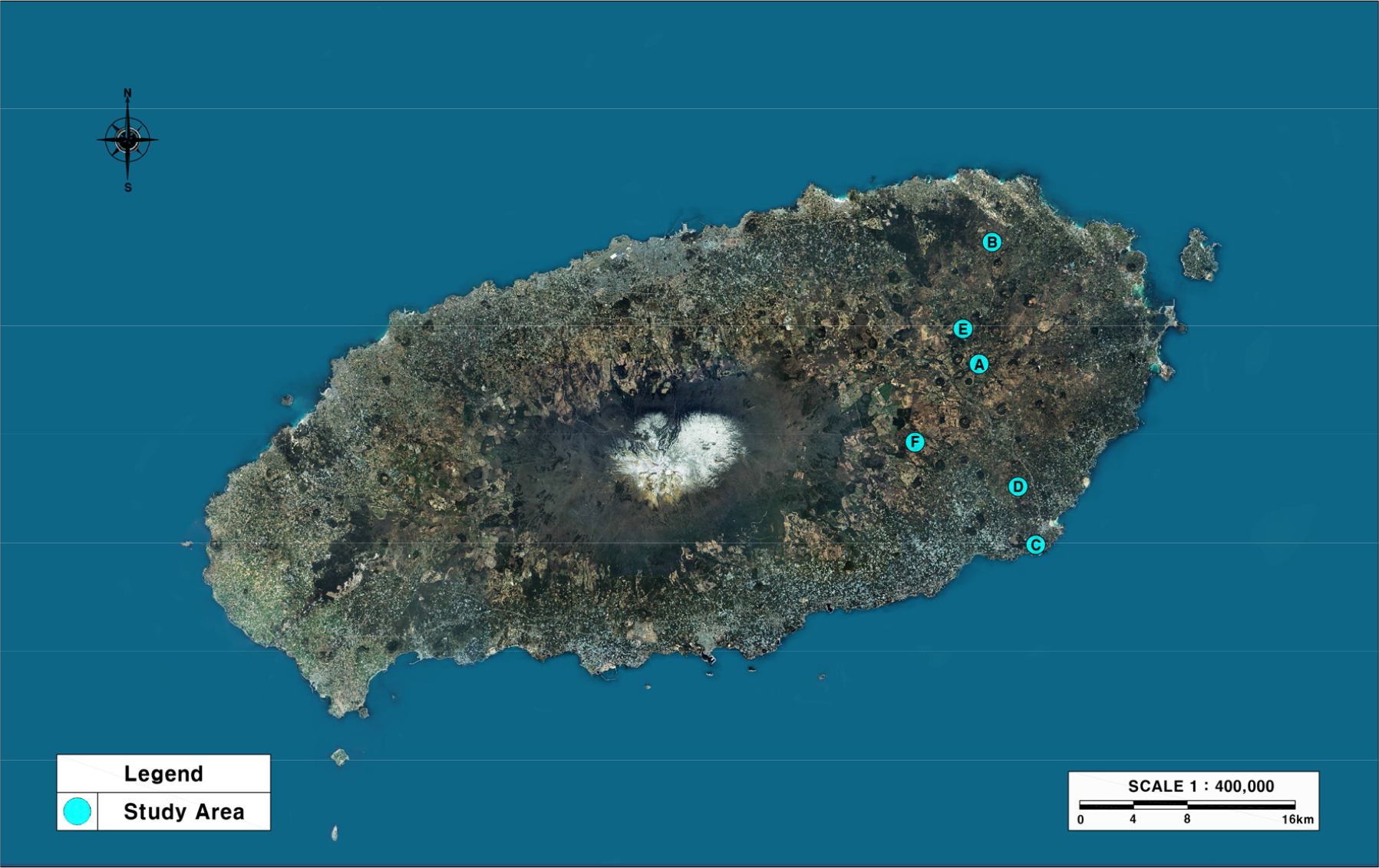
- This study compared the existing Hydrologic Soil Groups (HSGs) with field permeability characteristics in six watersheds in Jeju Island and analyzed changes in Curve Number (CN) and peak flood discharge according to HSG application scenarios. Although all study sites were classified as HSG D in the existing soil data, field permeability tests indicated relatively high permeability. Accordingly, HSG A was applied as a comparative scenario to evaluate the effects of field-observed permeability characteristics. Flood discharges were estimated under identical rainfall and watershed conditions in accordance with the Disaster Impact Assessment Practical Guidelines. The results showed that, under the HSG A scenario, the average CN decreased by 36.6% before development and 30.0% after development, while the peak flood discharge decreased by 56.9% and 47.1%, respectively. These results suggest that, when estimating flood discharge in Jeju Island, the applicability of existing HSG classifications should be evaluated in conjunction with field permeability characteristics rather than applying existing HSG classifications uniformly.
- COLLAPSE
본 연구에서는 제주지역 6개 유역을 대상으로 기존 수문학적 토양군(HSG)과 현장 투수특성을 비교하고, HSG 적용조건에 따른 유출곡선지수(CN) 및 첨두홍수량의 변화를 분석하였다. 기존 토양자료에서는 모든 대상지가 HSG D로 분류되어 있으나, 현장 투수시험에서는 상대적으로 높은 투수특성이 확인되어 이를 고려한 HSG A 비교 시나리오를 설정하였다. 홍수량은 「재해영향평가 실무지침」에 따라 동일한 강우 및 유역조건에서 산정하였다. 분석 결과, HSG A 가정조건에서 CN은 개발 전·후 각각 평균 36.6%, 30.0% 감소하였으며, 첨두홍수량은 각각 56.9%, 47.1% 감소하였다. 이러한 결과는 제주지역의 홍수량 산정 시 기존 HSG의 일률적인 적용보다 현장 투수특성과의 적합성을 함께 검토할 필요가 있음을 시사한다.
-
Analysis of Flood Runoff Characteristics in Eastern Jeju Island According to the Application of Hydrologic Soil Groups Considering Field Permeability Characteristics
-
Original Article
-
Development of a Finite-element-based Probabilistic Seepage Analysis Code for River Levee Fragility Assessment
하천제방 침투 취약도 평가를 위한 유한요소 기반 확률해석 코드 개발
-
Du Han Lee, Seongwook Choi
이두한, 최성욱
- This study developed KSeep2D-PF, a finite-element-based probabilistic seepage analysis code for assessing river levee fragility while accounting for uncertainty in soil hydraulic …
본 연구에서는 지반 수리특성의 불확실성을 고려하여 하천제방의 침투 취약도를 평가할 수 있는 유한요소 기반 확률론적 침투해석 코드 KSeep2D-PF를 개발하였다. 개발 코드는 2차원 …
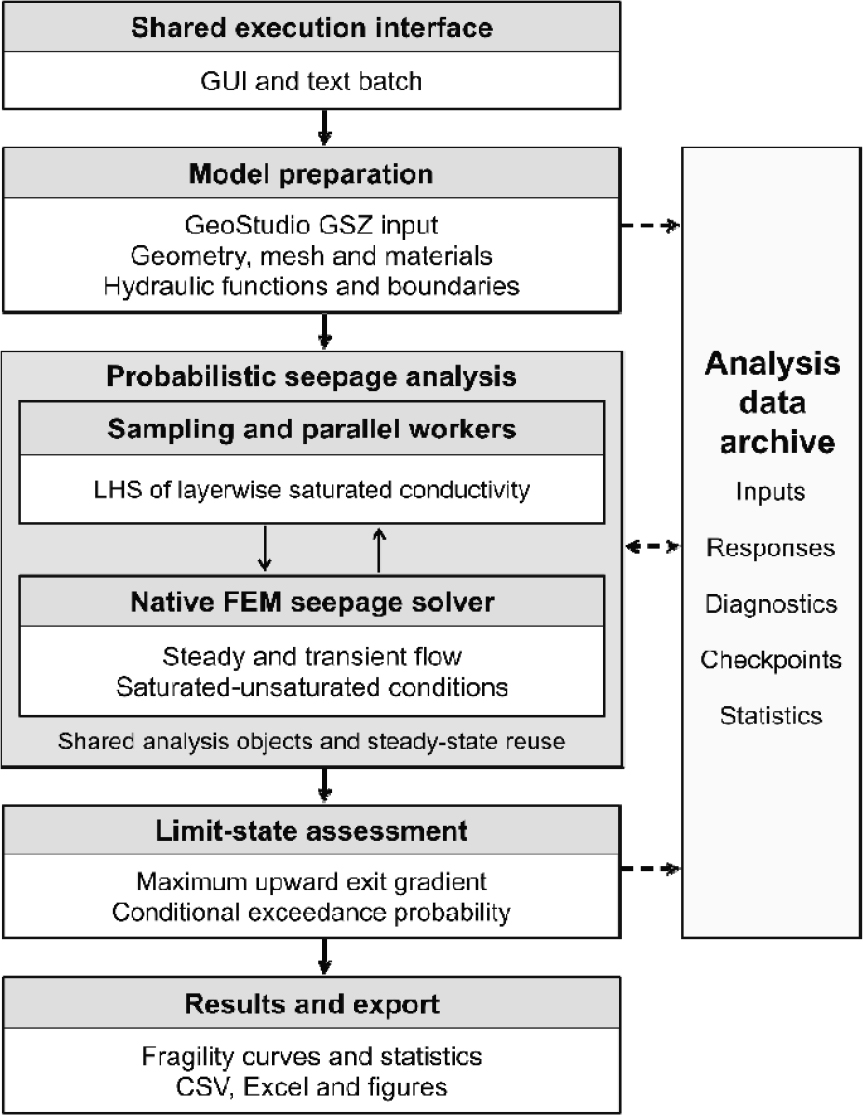
- This study developed KSeep2D-PF, a finite-element-based probabilistic seepage analysis code for assessing river levee fragility while accounting for uncertainty in soil hydraulic properties. The code integrates two-dimensional saturated-unsaturated seepage analysis, sampling of layer-specific saturated hydraulic conductivity, repeated simulations, limit-state evaluation based on the maximum upward exit gradient, and sample-level parallel processing. Verification using steady and transient seepage problems demonstrated accuracy comparable to analytical or reference solutions and SEEP/W results. For the IBH11 section of the Miho River levee, the limit-state exceedance probability increased from 0.005 to 0.615 as the river stage increased. Across 17 levee sections, the exceedance probability at the highest evaluated river stage for each section ranged from 0.000 to 0.790. Some sections exhibited substantial exceedance probabilities even when the deterministic factor of safety satisfied the required criterion, demonstrating the importance of probabilistic evaluation. The estimated speedup using 18 worker processes ranged from 14.38 to 15.86. KSeep2D-PF provides an integrated workflow from probabilistic input generation to seepage analysis, limit-state evaluation, and statistical aggregation. The code is expected to complement conventional deterministic assessments and facilitate the practical application of probabilistic seepage safety evaluation for river levees in Korea.
- COLLAPSE
본 연구에서는 지반 수리특성의 불확실성을 고려하여 하천제방의 침투 취약도를 평가할 수 있는 유한요소 기반 확률론적 침투해석 코드 KSeep2D-PF를 개발하였다. 개발 코드는 2차원 포화·불포화 침투해석, 지층별 포화투수계수의 표본 생성, 반복해석, 최대 상향 유출동수경사에 따른 한계상태 판정 및 표본 단위 병렬처리를 통합한다. 정상·비정상 침투 검증문제에 적용한 결과, 기준해 및 SEEP/W와 유사한 수준의 정확도를 확인하였다. 미호강 IBH11 단면에서는 외수위 상승에 따라 한계상태 초과확률이 0.005에서 0.615로 증가하였으며, 17개 단면의 최고 검토수위에서는 0.000–0.790의 범위로 나타났다. 일부 단면에서는 결정론적 안전율이 요구기준을 만족하더라도 유의한 초과확률이 산정되어 확률론적 평가의 필요성이 확인되었다. 또한 18개 작업자 프로세스를 적용한 추정 속도향상비는 14.38–15.86배로 나타났다. 개발 코드는 확률 입력 생성부터 침투해석, 한계상태 판정 및 결과 집계까지 일관되게 수행할 수 있으며, 국내 하천제방 실무에서 결정론적 평가를 보완하고 확률기반 침투 안전성 평가의 적용을 활성화하는 데 활용될 수 있을 것으로 기대된다.
-
Development of a Finite-element-based Probabilistic Seepage Analysis Code for River Levee Fragility Assessment

Journal Informaiton
 Ecology and Resilient Infrastructure
Ecology and Resilient Infrastructure







 Korean Society of Ecology and Infrastructure Engineering
응용생태공학회
Room 1514, #20, Teheran-ro 25-gil, Gangnam-gu, Seoul 06130, Korea
Tel: +82-2-552-7550 / Fax: +82-2-552-7549 / E-mail: kseie2013@gmail.com Copyright© Korean Society of Ecology and Infrastructure Engineering. Powered by APUB
Tel: +82-2-552-7550 / Fax: +82-2-552-7549 / E-mail: kseie2013@gmail.com Copyright© Korean Society of Ecology and Infrastructure Engineering. Powered by APUB