1. 서 론
2. 연구방법
3. 적정성 검토 및 분석 결과
4. 결 론
1. 서 론
환경부는 지난 2021년 7월 4대강 수계의 차기단계 수질오염총량관리제도 (이하 ‘총량제’)를 시행하였다. 총량제는 관리하고자 하는 하천의 목표 수질을 정하고 목표 수질을 달성·유지하기 위한 수질오염물질의 허용부하량 (허용총량)을 산정하는 제도이다 (Ministry of Environment Yeongsan River ․ Seomjin River Water System Management Committee 2020). 이 제도는 개별오염원에서 배출허용기준을 준수하여도 하천에 유입되는 오염물질의 양이 늘어나 수질환경기준을 초과하는 한계에 도달하게 되므로 수계를 단위유역별로 구분하여 목표 수질 및 오염물질의 배출 한도 총량을 설정하여 관리해야 하는 필요성에 의해 도입되었다. 총량제의 추진 절차는 Fig. 1과 같다 (Ministry of Environment Geumgang River Basin Environment Agency 2020).
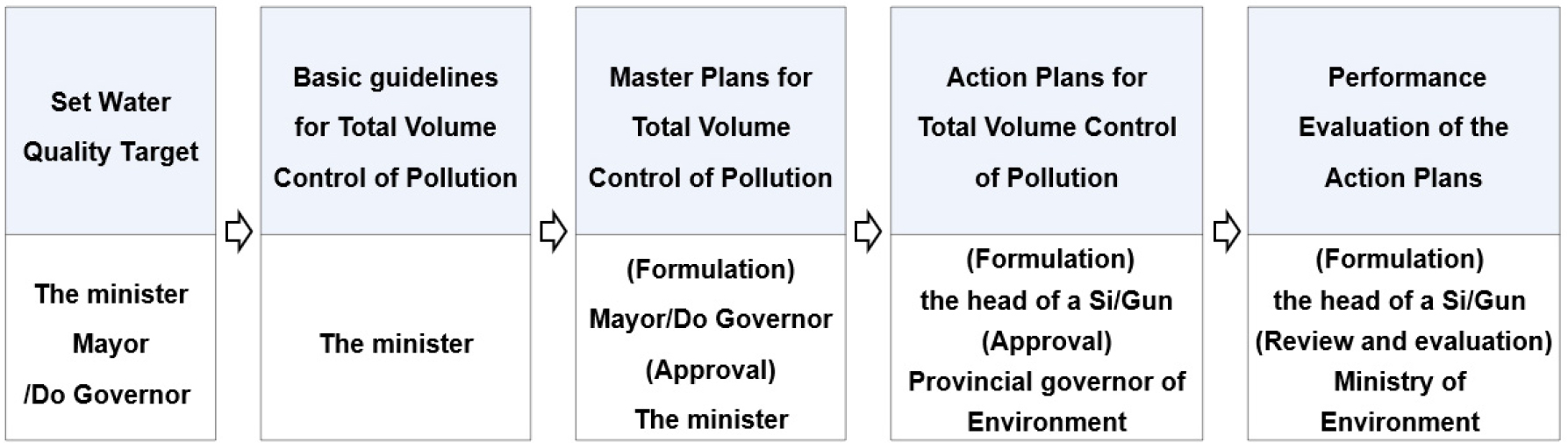
Fig. 1.
Management of TMDLs system procedure.
본 논문에서는 총량제 추진 절차 중 지자체별로 수립한 오염총량관리 시행계획의 적정 이행여부 등을 평가하는 ‘시행계획 이행평가 (이하 ’이행평가‘)’ 사업의 대가산정 방안에 대하여 연구하였다. 이행평가 사업은 수질오염총량관리제도 시행계획수립 대상 단위유역을 관할하고 있는 지자체에서 발주하고 있다. Fig. 2와 같이 지난 2019년 공공 발주현황을 살펴보면 총 발주금액은 6,258백만원, 119건으로 확인되었다.
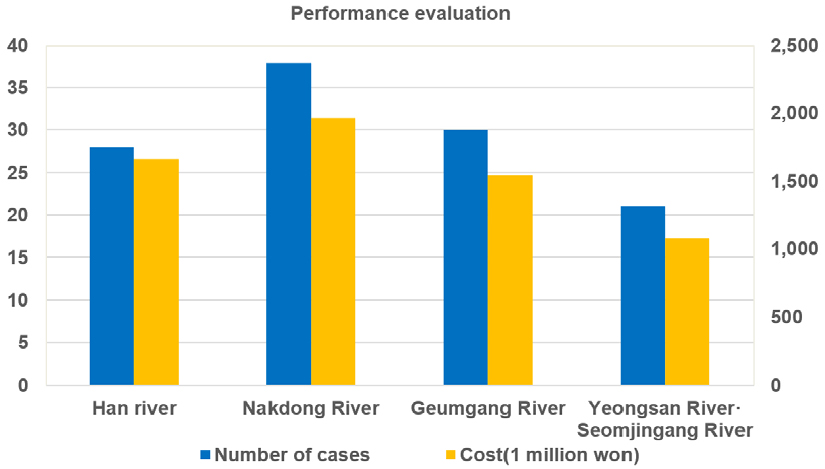
Fig. 2.
Public order status for performance evaluation on each river basin (2019).
기존 이행평가 사업의 대가는 ‘이행평가 용역비 지원기준 (Ministry of Environment 2009)’에 따라 산정되고 있다. 지원기준에 따르면 기본금 40백만원에 면적과 인구수에 따른 가산금의 합계로 대가가 산출되며, 면적이 10 km2 미만 또는 인구가 1천명 미만인 지역의 경우 대가는 15백만원으로 산출된다. 그러나, Fig. 3과 같이 사업비 15백만원 대상의 사업과 40백만원 사업과 비교 시 인구나 면적에 큰 차이가 나지 않음에도 불구하고 기본금과 최소금액에 큰 차이가 발생하는 것을 확인하였다. 그리고, 수계별로 다른 특성을 갖음에도 불구하고 대다수의 사업들이 동일한 금액에 분포하고 있어 면적과 인구 규모 이외 사업의 세부적인 특성을 고려한 사업비 산정 연구가 필요하다는 것을 확인하였다.
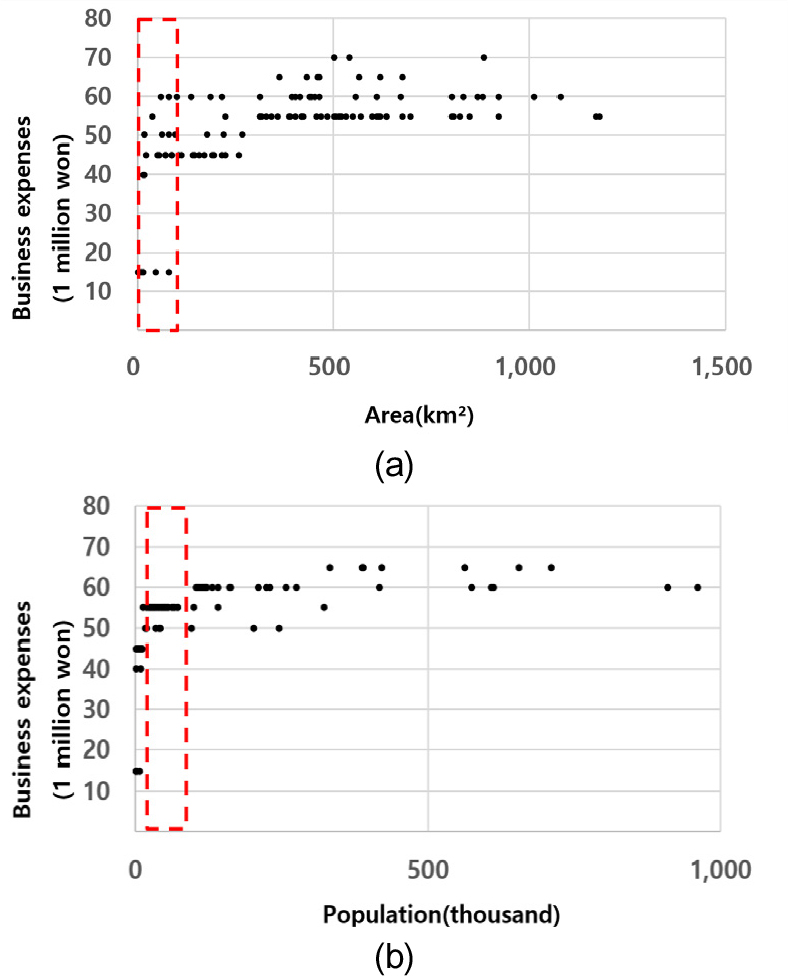
Fig. 3.
Distribution of ordering cases in 2019 by area (up) and population (down).
2. 연구방법
이행평가는 자지자체별 시행계획의 적정 이행 여부 등을 매년 평가하여 연차별 할당 부하량을 초과 시 개발계획 변경, 추가 삭감계획 수립 등 필요한 조치를 취함으로써 단위 유역 목표수질 달성에 기여하도록 하는 업무로 엔지니어링활동에 해당한다고 볼 수 있다 (Ministry of Environment Geumgang River Basin Environment Agency 2020). 엔지니어링활동은 Fig. 4와 같이 과학기술의 지식을 응용하여 수행하는 사업이나 시설물에 관한 연구, 기획, 타당성 조사, 설계, 분석, 시험, 평가, 검사, 안전성 검토, 관리 등을 말한다 (Ministry of trade, industry and energy 2020).
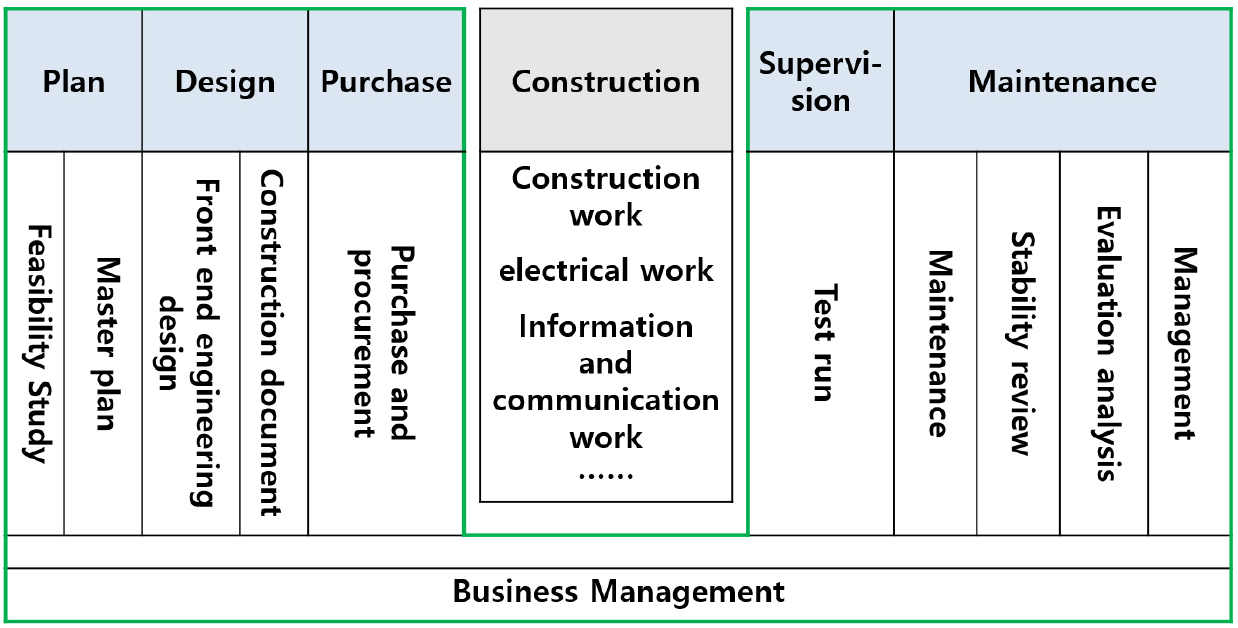
Fig. 4.
Range of engineering business.
엔지니어링사업은 엔지니어링사업대가의 기준 (Ministry of trade, industry and energy act 2021)에 의거 Table 1과 같이 실비정액가산방식에 따라 대가를 산정하는 것이 기본 원칙이다. 실비정액가산방식이란 직접인건비, 직접경비, 제경비, 기술료와 부가가치세를 합산하여 대가를 산출하는 방식을 말한다. Fig. 4와 같이 직접인건비는 해당 엔지니어링 업무를 수행하는 기술자의 투입인원수 즉, 품셈에 엔지니어링 기술자별 노임단가를 곱하여 산정하며, 노임단가는 매년 공표되는 엔지니어링협회의 임금실태조사 결과를 적용한다. 직접경비는 업무 수행과 직접적으로 관련이 있는 경비로서 실제 소요될 것으로 추정되는 비용의 일체를 계산하여 산정한다. 제경비는 업체의 행정운영 등을 위해 발생하는 간접경비로 직접인건비의 110 - 120%로 계산하고, 기술료는 엔지니어링사업자가 개발·보유한 기술의 사용 및 기술축적을 위한 대가로서 직접인건비에 제경비를 합한 금액의 20 - 40%로 계산한다 (Ministry of trade, industry and energy act 2021).
Table 1.
Actual cost stipulated sum agreement
|
Type
|
Actual cost stipulated sum agreement
|
|
Calculation method
|
Direct cost + direct expenses + overhead expenses + technical fees
|
|
Category
|
Direct labor cost
|
· Labor cost of an engineering technician directly engaged in the work of the relevant engineering
business
· Number of input(man·day) × The unit price of wages by skill levels
|
|
Direct expenses
|
· Expenses directly related to the performance of the relevant duties, such as travel expenses,
special data expenses, printing and blueprint expenses, survey expenses, examination and
survey expenses, model production expenses, etc.
· Calculate all estimated costs
|
|
Overhead expenses
|
· Indirect expenses incurred in planning, management, general affairs, etc. for the administrative
operation of the company without being included in direct expenses (direct labor and direct
expenses), such as salary, office expenses, office expenses, equipment expenses, repair and
amortization expenses, meeting expenses, utility bills, and operation activities
· Direct labor cost × (110 - 120 %)
|
|
Fixed payment
|
· Research and research expenses, technology development expenses, technology training
expenses, and profits, etc. as consideration for the development, use of the technology
possessed, and technology accumulation of technology by an engineering business operator
· (Direct labor cost + expenses) × (20 – 40 %)
|
직접인건비의 투입인원수를 산출하는 경우에는 산업부 장관이 인가한 표준품셈을 우선 적용하게 되어있으나, 현재 이행평가 사업은 관련 표준품셈이 없어 본 연구에서는 기존 용역비 지원기준을 검토하고 상세한 사업의 규모와 난이도를 고려한 품셈 제정을 통해 실비정액가산방식을 적용한 이행평가 대가산정 방안을 연구하였다. 타당한 엔지니어링 품셈 마련을 위해서 기술자의 업무일지를 바탕으로 기준인력수가 산정되는 것이 바람직하나, 현재 엔지니어링 사업자는 명확한 업무일지 자료를 구축하지 못하고 있어 Fig. 5와 같은 연구절차를 통해 투입인원수를 산정하였다 (Korea Engineering and Consulting Association 2018).
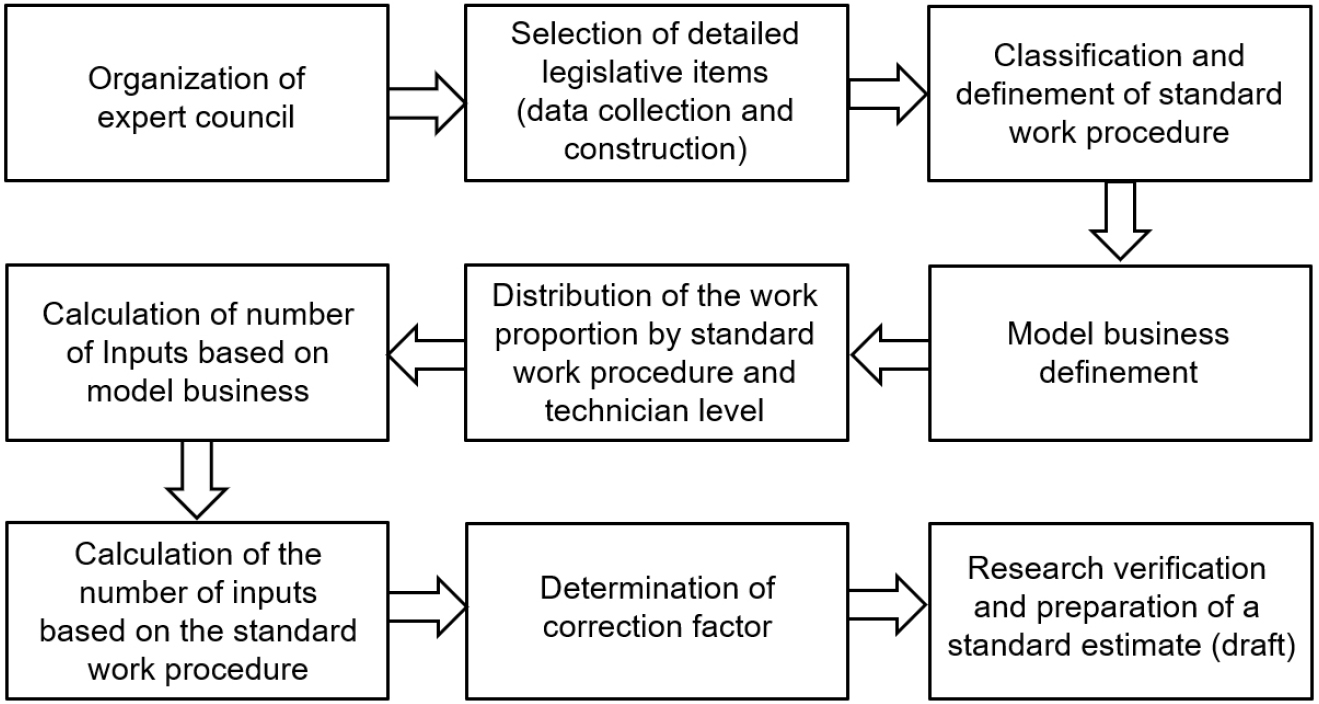
Fig. 5.
Engineering standard estimate legislative research procedure.
우선, 총량제 이행평가 관련 업계 전문가로 구성된 전문가협의회 (11인)를 구성하고, 각 수계관리위원회를 통해 발주사례 및 관련 법령정보를 수집하였다. 다음 절차인 기준업무 분류 및 정의는 엔지니어링사업을 효율적으로 수행 및 관리하기 위해 주요 절차 및 항목을 제시하는 것으로 기본업무, 세부업무 등으로 분류한다. 이행평가 품셈 마련을 위한 기준업무는 오염총량관리시행계획 이행평가기준 (환경부고시 제2018-8호, 2018)[별표 3] 및 관련 과업지시서 분석, 전문가협의회 의견수렴 등을 거쳐 Table 2와 같이 분류 및 정의하였다.
Table 2.
Classification and definition of performance evaluation baseline tasks
|
Category
|
Work definition
|
Task
preparation
|
Preparation for
commencement
|
Preparation and submission of documents, including the contractor, field agent,
and security memorandum, etc.
|
Preparation of task
performance plan
|
Preparation and submission of a task performance plan, such as details, direction,
method, detailed plan table, schedule of participating professionals and organizational
organization in each field, project promotion plan (schedule) table, and other
necessary matters
|
Basin
Environmental
Survey
|
Overview of Basin
Environment
|
Investigate and prepare the current status of owned and administrative areas subject
to performance evaluation, rivers and appeals, and prepare and attach the current
status of the target basin as a map
|
Water system
environment survey
|
(1)Collection and organization of results of water quality and flow rate investigation
of pollutant discharge and reduction facilities (environmental basic facilities,
sewage and wastewater discharge facilities, and non-point pollution reduction
facilities)
(2)Collecting and organizing the results of the water quality and flow survey at the
inflow and outflow points of the total volume management unit, and evaluating
the target water quality
(3)Collection and arrangement of water quality and flow survey results at major
points of a river in the total volume management unit basin
|
Sources and
Loads of
Contaminants
|
Investigation of
pollutants
|
(1)Collecting national pollutant source survey data and reviewing suitability
(2)A Study on the Basic data for the estimation of contamination Loads
(3)Investigation and analysis of contaminants by administrative region and unit basin
(4)Calculation of standard discharge water quality by environmental infrastructure
(regularity review)
(5)Supplementation and modification according to the review results of the review
agency
|
Calculation of
contamination/reduction
load
|
(1)Calculation of pollution load by substance to be managed, by unit basin, and
by pollutant group
(2)Supplementation and modification according to the review results of the review
agency
|
Performance
evaluation
|
Pollutant source and
load assessment
|
(1)Evaluation and Analysis of Pollutant Source Investigation Data for each Unit Basin
against the Implementation Plan
(2)Evaluation and analysis of pollution load by substance to be managed, unit basin,
and pollution source compared to the implementation plan
|
Analysis of flow rate and
water quality
measurement data
|
Analysis of Water Quality and Flow Measurement Data at the River Monitoring Point
(Water quality evaluation and LDC analysis by flow section for unit basin and small river)
|
Data Analysis for
Development Projects
|
(1)Initial Development Project Performance Evaluation
(2)Investigation on the status of total volume consultation for development projects
in the current year
(3)Evaluation of exhaustion of regional development load consultation
(4)Investigation of the completion status of the development project in the current
year and evaluation of the implementation plan
(5)A Study on the Implementation of Non-Point Pollution Reduction Plan for Regional
Development Projects
(6)Preparation of documentary evidence of development performance and related
data (building license ledger and non-point pollution reduction material
maintenance record ledger, etc.)
|
Evaluation of Reduction
Performance by
Reduction Facility
|
Evaluation of the performance of each reduction facility for the implementation plan
reduction plan, calculation of the reduction load, and preparation of documentary
evidence of the reduction performance
|
Assessment of
allocation load
|
(1)Assessment of allocation load by substance to be managed, unit basin,
and pollutant source
(2)Assessment of compliance with allocation load of allocation facilities
(3)Supplementation and modification according to the review
results of the review agency
|
|
Cause analysis
|
An Analysis of the Excess Load and the Cause of Achievement of Annual Allocation
according to the Implementation Plan
|
|
Action plan
|
Action plan
|
(1)Development plan, allocation load, and reduction plan adjustment plan based
on the evaluation of compliance with allocation load by unit basin
(2)Prepare other measures as necessary
|
Creating a
product
|
Create and submit
reports
|
Prepare and submit reports in accordance with current guidelines such as
performance assessment overview and report summary
|
모델사업은 전문가들의 직관적이고 경험적인 기준업무의 비중배분이 원활히 이루어질 수 있도록 사업의 일반적 특성을 반영하고 있으며, 일련의 엔지니어링 업무가 포함되어 있는 발주 빈도가 높은 사업을 선택한다 (Korea Engineering and Consulting Association 2018). 2019년 이행평가 발주사례를 분석한 결과 가장 빈번하게 발주된 사업은 55백만원 사업으로 총 119건의 발주사례 중 41건 (약 34.5%)을 차지하고 있음을 Fig. 6에서 확인할 수 있다. 따라서, 모델사업은 발주금액 55백만원으로 단위유역수 3개, 면적 500 km2 , 인구 70천명, 폐수배출업소 100개소, 축산두수 1500천두를 갖는 사업으로 선정하고 모델사업에 대한 기준업무별, 기술자 등급별 비중배분을 수행하였다.
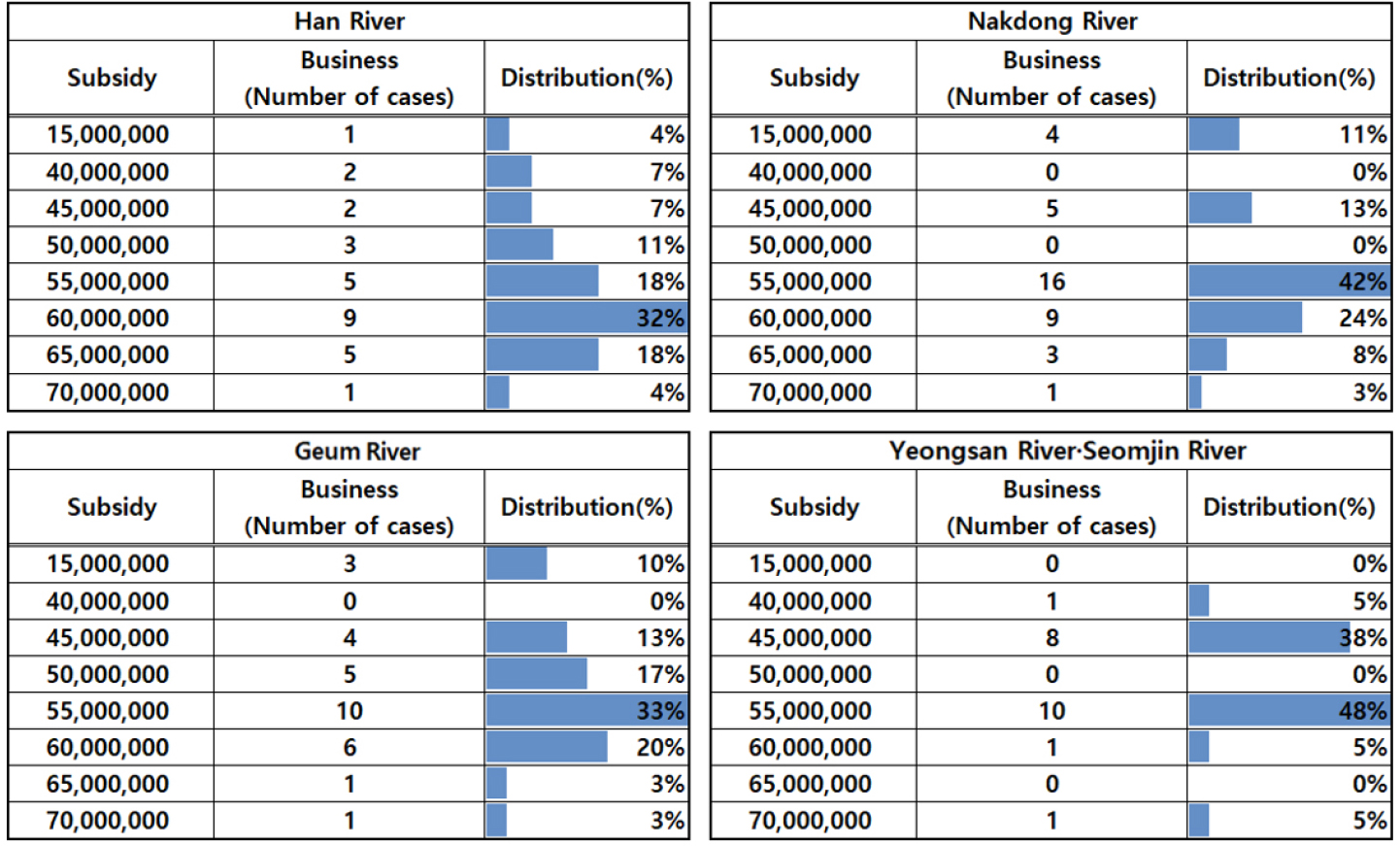
Fig. 6.
Business expenses distribution of performance evaluation on each river basin(‘19).
비중배분은 전체 사업 수행 시 각 세부업무가 어느 정도의 비중을 차지하는지 상대적으로 배분하는 업무로, 각 전문가가 제시한 기준업무별, 기술자 등급별 비중의 이상값을 제거한 평균값 및 최빈값을 참고하여 Table 3과 같이 도출하였다. 주요 업무인 오염원 및 부하량이 가장 큰 비중인 전체비중의 약 40%를 차지하는 것으로 나타났고, 그 외 이행평가가 차지하는 비중이 큰 것으로 나타났다.
Table 3.
Percentage of work by standard work criteria for performance evaluation and technician grade
|
Standard work
|
Detailed work
|
Relative
Importance
(%)
|
Percentage by technician level (%)
| |
|
Special
|
Advanced
|
Intermediate
|
Beginner
|
Sum
|
|
Task preparation
|
Preparation for
commencement
|
1
|
56
|
24
|
20
|
0
|
100
|
Preparation of task
performance plan
|
1
|
14
|
19
|
60
|
7
|
100
|
Investigation of
watershed
environment survey
|
Overview of basin
environment
|
1
|
0
|
0
|
42
|
58
|
100
|
Water system
environment survey
|
3
|
0
|
5
|
43
|
52
|
100
|
Sources and loads of
Contaminants
|
Investigation of
pollutants
|
25
|
10
|
22
|
46
|
22
|
100
|
Calculation of contamination and
reduction load
|
15
|
10
|
30
|
40
|
20
|
100
|
Performance
evaluation
|
Pollutant source and
load assessment
|
5
|
1
|
35
|
45
|
19
|
100
|
Analysis of flow rate
and water quality
measurement data
|
4
|
0
|
14
|
49
|
37
|
100
|
Data analysis for
development projects
|
8
|
5
|
31
|
47
|
17
|
100
|
Evaluation of reduction
performance by
reduction facility
|
5
|
4
|
20
|
56
|
20
|
100
|
Assessment of
allocation load
|
4
|
0
|
20
|
65
|
15
|
100
|
|
Cause analysis
|
9
|
24
|
37
|
33
|
6
|
100
|
|
Action plan
|
Action plan
|
10
|
25
|
30
|
34
|
11
|
100
|
|
Work result
|
Make a report
|
10
|
28
|
20
|
39
|
14
|
100
|
|
Sum
|
100
|
-
|
-
|
-
|
-
|
-
|
모델사업기반의 투인원수는 연구진회의 3회, 전문가협의회 3회를 개최하여 업무 간 투입인원수 상관관계, 기존 발주사례에 제시된 사업비, 업무별 비중 배분, 유사분야 투입인원수 등을 참고하여 산정하였으며, 이 모델 단위 기반의 투입인원수를 다시 기준업무 표준단위의 투입인원수로 변환하는 과정을 거친다. 이 과정에 있어 ‘규모 및 난이도 등 보정계수 결정’ 단계에 대한 변화 가능한 개략적인 방향을 추정하고, 모델사업의 업무량 대비 기준업무 표준단위의 업무량 비율 등을 검토한다 (Korea Engineering and Consulting Association 2018). 마련된 모델사업의 투입인원수에 전문가협의회 의견 및 업계 설문조사를 토대로 기준사업을 단위유역 1개 기준, 면적 10 km2, 인구 2천명, 폐수배출업소 5개소, 축산 10천두를 갖는 사업으로 정의하고 기준단위 선정 및 기준인원수를 Table 4와 같이 산정하였다.
Table 4.
Number of workers for standard performance evaluation business
|
Standard work
|
Detailed work
|
Unit
|
Number of inputs by technician level
|
|
Special
|
Advanced
|
Intermediate
|
Beginner
|
|
Task preparation
|
Preparation for commencement
|
1 Unit
|
0.40
|
0.19
|
0.19
| |
Preparation of task performance
plan
|
1 Unit
|
0.10
|
0.15
|
0.57
|
0.07
|
Investigation of
watershed
environment survey
|
Overview of basin environment
|
Unit basin
| | |
0.10
|
0.15
|
|
Water system environment survey
|
Unit basin
| |
0.03
|
0.30
|
0.40
|
Sources and loads
of Contaminants
|
Investigation of pollutants
|
1 Unit
|
0.57
|
1.38
|
3.52
|
1.84
|
Calculation of contamination and
reduction load
|
Unit
|
0.34
|
1.13
|
1.84
|
1.01
|
Performance
evaluation
|
Pollutant source and
load assessment
|
Unit basin
|
0.01
|
0.33
|
0.52
|
0.25
|
Analysis of flow rate and water
quality measurement data
|
Unit basin
| |
0.11
|
0.45
|
0.37
|
Data analysis for development
projects
|
Unit basin
|
0.07
|
0.47
|
0.87
|
0.35
|
Evaluation of reduction
performance by reduction facility
|
Unit basin
|
0.04
|
0.19
|
0.65
|
0.25
|
|
Assessment of allocation load
|
Unit basin
| |
0.14
|
0.53
|
0.14
|
|
Cause analysis
|
Unit basin
|
0.35
|
0.60
|
0.65
|
0.13
|
|
Action plan
|
Action plan
|
Unit basin
|
0.43
|
0.57
|
0.78
|
0.28
|
|
Work result
|
Make a report
|
Unit basin
|
0.48
|
0.37
|
0.89
|
0.36
|
또한, 업계 설문조사를 통해 각 세부 업무에 영향을 미치는 환산계수 및 보정계수를 조사한 결과, 면적 및 인구수 이외 Table 5와 같이 단위유역수, 축산두수, 폐수 배출업소수 등이 확인되었다. 환산계수는 수행하고자 하는 사업 규모와 표준단위 규모의 차이에 따라 업무의 유사성, 반복성을 적용 수량에 반영하여 적정한 업무량을 산출하기 위한 계수이며 보정계수는 사업의 특성에 따른 업무량의 변화를 반영하는 계수로, 적정한 환산계수와 보정계수를 마련을 통해 현실성 있는 대가를 산정할 수 있다. 일반적으로 엔지니어링사업의 투입인원수는 물량의 변화에 따라 산술적으로 증가하지 않은 경향을 나타내고 있어 각 사업의 특성을 고려한 환산계수 선정이 중요하다. 난이도 보정계수는 환산계수를 제외한 투입인원수 변화에 영향을 미치는 모든 인자를 나열한 후 중복성을 검토하고, 활용성 측면을 고려하여 적용 보정계수를 합리적으로 최소화하여 선정한다 (Korea Engineering and Consulting Association 2018).
Table 5.
Correction coefficient for detailed tasks of performance evaluation
|
Standard work
|
Detailed work
|
Correction factor
|
|
Unit basin
|
Population
|
Wastewater
discharge
business
|
Number of livestock
|
|
Task preparation
|
Preparation for commencement
| | | | |
|
Preparation of task performance plan
| | | | |
Investigation of watershed
environment survey
|
Overview of basin environment
|
●
| | | |
|
Water system environment survey
|
●
| | | |
Sources and loads of
Contaminants
|
Investigation of pollutants
| |
●
|
●
|
●
|
Calculation of contamination and
reduction load
| |
●
|
●
|
●
|
|
Performance evaluation
|
Pollutant source and load assessment
|
●
| | | |
Analysis of flow rate and water quality
measurement data
|
●
| | | |
|
Data analysis for development projects
|
●
| | | |
Evaluation of reduction performance by
reduction facility
|
●
| | | |
|
Assessment of allocation load
|
●
| | | |
|
Cause analysis
|
●
| | | |
|
Action plan
|
Action plan
|
●
| | | |
|
Work result
|
Make a report
|
●
| | | |
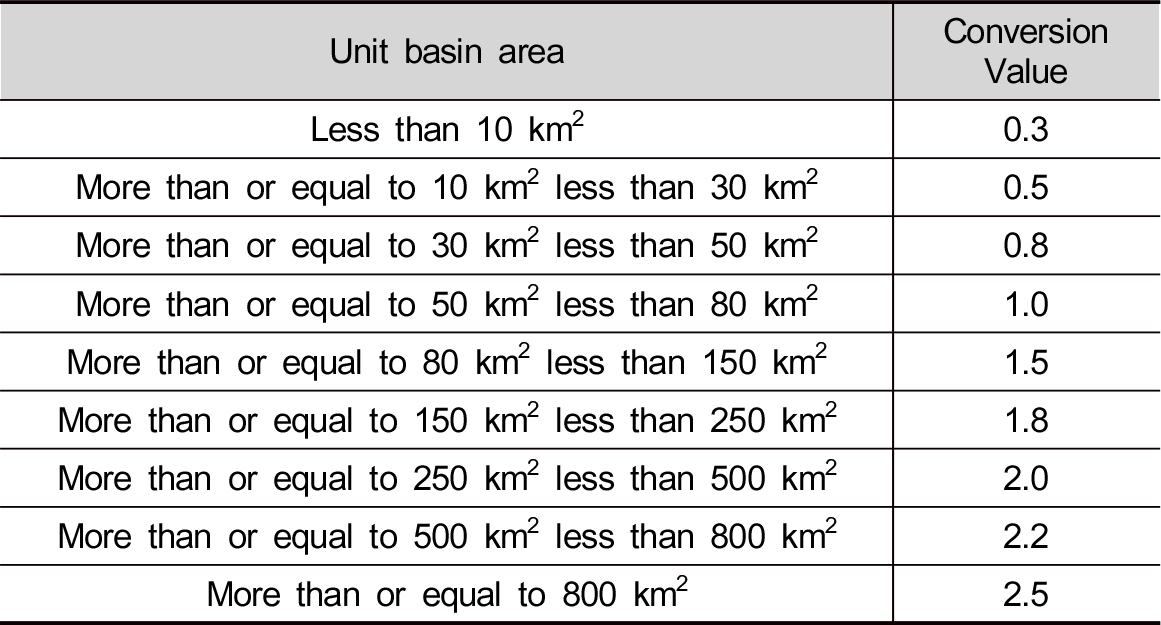
환산계수 산정을 위하여 단위유역을 면적에 따라 군집화하고, 단위유역별 면적에 따라 산정된 환산값을 합산하여 환산계수를 적용하여 적정대가를 산출할 수 있도록 하였으며, 인구와 폐수배출업소수, 축산두수에 해당하는 업무의 난이도는 보정계수로 Table 6과 같이 산정하였다. 다양한 보정계수를 적용하여 실제 발주 가능한 사업의 엔지니어링사업 대가가 적정하게 예측되는지 확인하고 투입인원수가 상식적 예측이 가능하게 거동하는지 확인하였다.
Table 6.
Conversion coefficient and correction coefficient of performance evaluation business
|
Type
|
Category
|
Detailed explanation
|
|
Conversion coefficient
|
①Unit basin
|
∙ Sum of Conversion coefficient =
※ α = Sum of Conversion Value
 |
|
Correction coefficient
|
Population
|
∙
※ A = Population(Number of people) of performance evaluation target area
|
|
Number of livestock
|
∙
∙
※ B = Number of livestock of performance evaluation target area
|
|
Wastewater discharge Business
|
∙
※ C = Number of wastewater discharge Business of performance evaluation target area
|
3. 적정성 검토 및 분석 결과
본 연구에서는 현실적이고 공신력이 확보된 이행평가 표준품셈 마련을 위하여 관련 법령 및 발주사례 등 자료검토, 업계 연구진을 구성하여 총 6회의 회의를 진행하고, 4회의 전문가협의회, 관계 법령 소관부처 담당자와 발주청, 학계 위원으로 구성된 부분위원회 2회 개최, 온라인 공청회 등을 거쳐 의견수렴의 과정을 거쳤다. Fig. 7은 총 119개의 이행평가 발주사례에 품셈 (안)을 적용한 대가를 분석한 결과로, 단위유역별 면적환산값이 증가하는 경우 사업비도 함께 증가하는 추세를 보이는 것을 확인하였다.
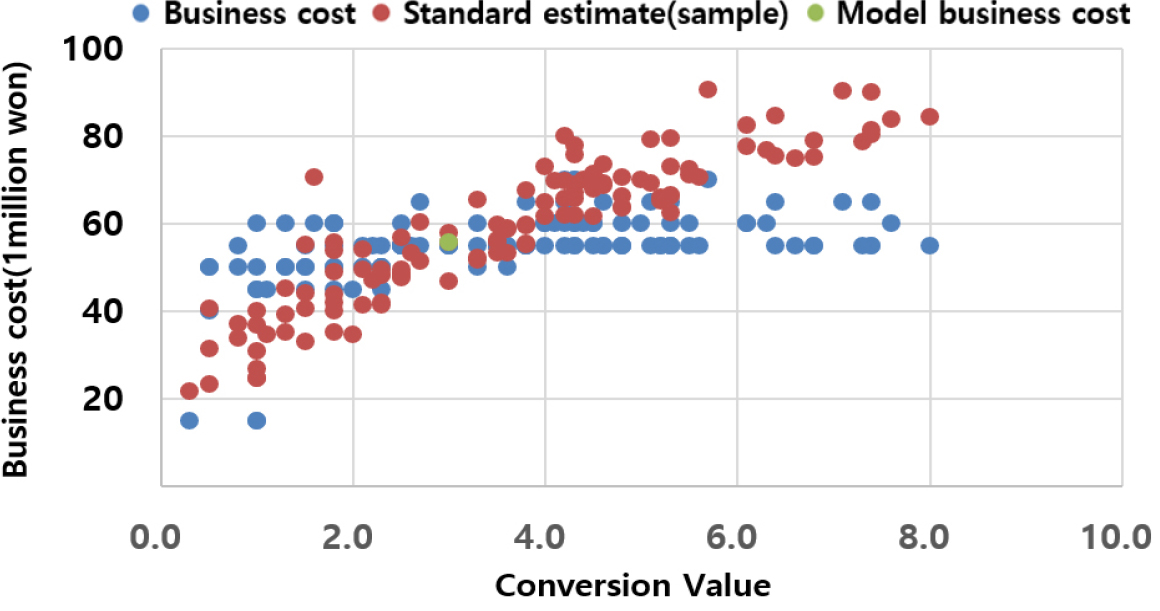
Fig. 7.
Comparison between performance evaluation actual cost and standard estimate(sample) based performance evaluation cost.
또한, Table 7과 같이 기존 사업비 대비 한강수계의 경우 평균 3%, 금강유역은 7%, 영산강 섬진강 유역은 5%, 낙동강유역은 8% 상승한 것을 확인하였다.
Table 7.
Standard estimate(sample) based business expenses on each river basin
|
River
|
Order case
(1 million won)
|
Standard estimate
(1 million won)
|
Variance
(%)
|
|
Han River
|
1,590
|
1,600
|
3
|
|
Geum River
|
1,615
|
1,683
|
7
|
|
Yeongsan River · Seomjin River
|
1,175
|
1,206
|
5
|
|
Nakdong River
|
2,100
|
2,217
|
8
|
4. 결 론
본 연구는 지난 2021년 시행된 수질오염총량관리제도에 따라 발주되는 시행계획 이행평가 사업의 기존 대가산정 방안을 검토하여 사업의 다양한 특성이 반영된 적정 대가를 산출할 수 있는 방법에 대하여 연구하였다. 사업비에 영향을 미치는 요인 중, 면적과 인구의 규모 외 유역단위별 면적, 축산두수, 폐수배출업소 등을 보정계수에 반영하고 업계 및 발주청, 소관부처 등으로 구성된 위원회 개최, 설문조사, 공청회 개최 등을 통하여 공신력을 확보하고자 하였다. 또한 각 수계별 발주사례를 검토하여 대가의 적정성을 검증하였다.
본 품셈 (안)에서는 인구, 단위유역별 면적, 폐수배출업소, 축산두수를 통해 보정계수를 산정하였으나, 이 항목이 생활계, 토지계, 산업계, 축산계 등의 모든 오염원을 반영하지는 못하고 있어, 향후 다양한 사업특성을 추가적으로 반영할 수 있도록 연구하고자 한다.