


1. Introduction
2. Materials and Methods
2.1 Red mud
2.2 Algal growth inhibition test
2.3 Acute toxicity evaluation test
3. Results and Discussion
3.1 Algal growth inhibition test
3.2 Acute toxicity evaluation test
3.3 Effect on pH
4. Discussion
1. Introduction
Red mud (RM) is a side-product of the Bayer process, and it is composed of a mixture of solid and metallic oxides (i.e., iron oxides, silica, un-leached residual alumina, and titanium oxide, etc.) (Akay et al. 1998, Tor and Cengeloglu 2006). The global waste of RM amounts to approximately 90 million tons/year, around 3 million tons of RM is reported to be used annually in the production of cement, road construction and as a source for iron. However, most RM is discarded into the ocean (Kumar et al. 2006). Due to the high alkalinity of RM, the discharge of RM is environmentally hazardous. Thus, the recent study focuses on the reuse and recycling of RM, and explores various processing methods that would widen the appli-cability of RM (Wang et al. 2008, 2009).
From previous studies, RM has been known to be effective in removing soluble metals (e.g., As3+,5+, Pb2+, and Cd2+) and PO43- (Akay et al. 1998, Mohan and Pittman 2007). However, due to its high alkalinity, RM has high pH levels ranging between 10 and 13. Moreover, RM contains high proportions of aluminum, iron, silicon, titanium oxides, and hydroxides, thus RM could be toxic to the environment (Bhatnagar et al. 2011). Bioassay tests have been widely used for evaluating toxicity in a variety of aquatic organisms. The advantages of bioassay testing of toxicity include the simple extraction of results and the test’s cost-effectiveness. In particular, toxicity tests using microorganisms provide simple and clear results on various experi-mental materials in a lab-scale setting (Farré et al. 2001).
In this study, an acute toxicity test of the RM produced for water purification using Pseudokir-chneriella subcapitata and Daphnia magna was performed. Based on the test results, an optimal concentration level of the produced RM was proposed and toxic effect of RM on the aquatic ecosystem was evaluated.
2. Materials and Methods
2.1 Red mud
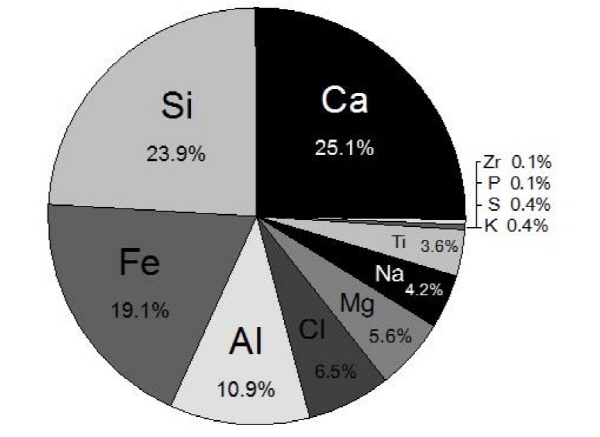
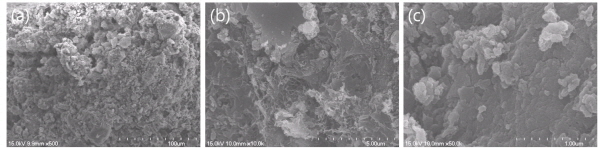
The porous red mud (RM) pellets were provided by “Company P.” The porous RM pellets mainly consisted of 12 components, including Ca 25.1%, Si 23.9%, Fe 19.1%, and Al 10.9% (Fig. 1). Scanning electron microscopy (SEM) images of the RM pellets indicated a heter ogeneous distribution of small and large crystals and many pores and channels (Fig. 2). Also, the specific surface area of the RM pellets is 100~120 m2/g, and high enough to adsorb the heavy metals or PO43-, forming FePO4, AlPO4, Ca3(PO4)2, and Mg3(PO4)2.
|
Fig. 2. Surface image of the red mud (RM) pellets using scanning electron microscopy apparatus (a, ×500; b, ×10,000; c, ×50,000). |
The RM solution was produced in compliance with the sample pretreatment for toxicity evaluation specified in the guidelines of the Marine Environ-ment Impact Assessment in the Republic of Korea (MLTMA 2010). A certain amount of RM pellets was mixed with distilled and deionized water at a ration of 1:10 under the continuous conditions for 6 hours (e.g., temperature 20°C, standard atmospheric pressure, shaking frequency 200 /min, and amplitude 4–5 cm). The extracted supernatant was filtered through filtering paper (pore size 1.0 µm) and centrifuged (9,000 rpm) for 15 min, which yielded the RM solution. The produced RM solution was diluted at certain ratio for an algal growth inhibition test and an acute toxicity evaluation test (see Table 1).
2.2 Algal growth inhibition test
The growth inhibition tests using freshwater algae were performed in compliance with the method of the Organization for Economic Cooperation and Development (OECD 1984). The National Institute of Environmental Research of Republic of Korea (NIER) provided Pseudokirchneriella subcapitata for the freshwater algae test. The early state of the algae was inoculated at a concentration of 1.0×10⁴ cells/mL, and each test was repeated four times (Guillard 1975). Each test was performed continuously for 96 hours in an incubator under constant conditions (e.g., temperature 20°C, light intensity 100 µmol m-2 s-1, light (16 hr) : dark (8 hr), and, shaking 100 rpm). Cell counting was performed on a time series using an optical microscope (Zeiss Axioplan, Germany). During the algal growth experiments, the specific growth rate (μ) of Pseudokirchneriella subcapitata was calculated based on Eq. (1).
 Eq. (1)
where Nt is the cell number of algae (cells/mL) on day t, and N0 is the initial cell number of algae (cells/mL). Also, the percent inhibition of growth rate was calculated based on Eq. (2).
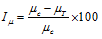 Eq. (2)
where Iμ is the percent inhibition in average specific growth rate (%), μC is the mean value for average specific growth rate (1/day) in the control group, and μT is the average specific growth rate (1/day) for the treatment replicate. Experimental conditions of algal growth inhibition applied in this study were summarized in Table 1.
2.3 Acute toxicity evaluation test
An acute toxicity evaluation test was performed on freshwater cladoceran, Daphnia magna, using the RM solution without pH adjustment. The NIER provided young D. magna (birth time<24 hr) for test purposes. In the static acute toxicity evaluation test, both feeding and culture fluid were avoided for the duration of the test (U.S. EPA 2002) under the continuous conditions (temperature 20°C, light intensity 100 µmol m-2 s-1, light (16 hr) : dark (8 hr), no shaking). The test continued for 24 hours until immobility was measured, where immobility is defined as the state where the D. magna did not swim for more than 15 min (Table 1). The immo-bilization rates at 24 hours were plotted against the test concentrations, and the probit method was used to determine the EC50 and toxic unit (=100/ EC50) values. Experimental conditions of acute toxicity valuation applied in this study were also summarized in Table 1.
3. Results and Discussion
3.1 Algal growth inhibition test
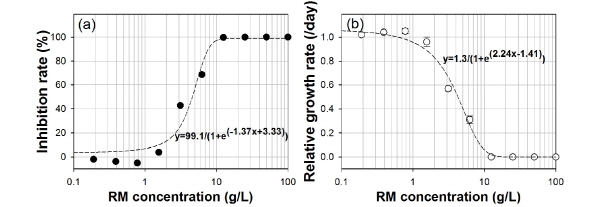
After observing the specific growth rates of Pseudokirchneriella subcapitata at different con-cen-trations of the red mud (RM) solution, both growth inhibition rates and the relative growth rates (μT/μC) were calculated. The specific growth rates of P. subcapitata during the tests ranged from 0.00 to 1.21 /day under the low concentration condition of the RM solution (<1.8 g/L).
The growth inhibition rates ranged from 5 to 100%, which were statistically significant (R=0.99, R2=0.97, p<0.001), and the growth inhibition rates dramatically increased in the range of 1.6–12.5 g/L of RM solution (Fig. 3a). Also, the relative growth rates sharply decreased in the range of 1.6–12.5 g/L, which were statistically significant (R=0.99, R2=0.99, p<0.001) (Fig. 3b). These results indicate that a higher concentration of RM would inhibit the algal growth and decrease the specific growth rate.
|
Fig. 3. Results of the inhibition rate (a) and the relative growth rate (b) of Pseudokirchneriella subcapitata with different concentration of red mud (RM) solution (p<0.001). |
3.2 Acute toxicity evaluation test
The acute toxicity evaluation test on freshwater cladoceran, Daphnia magna, was performed with the prepared RM solution. As a result, the EC50 value was found to be 35.3 g/L, and the toxic unit (TU) values increased to 2.83 with the increase in the RM concentration. Also, immobility of D. magna was proportional to the concentration of RM, and significantly increased in the range of 4.4–8.8 g/L of RM concentration (Table 2).
In general, a substance is considered nontoxic when the TU value is less than 1.0 (Park and Kim 2012). From this study, TU values were found to be lower than 1.0 when the RM concentration was below 4.4 g/L. When the RM concentration was greater than this threshold value (i.e., 4.4 g/L), TU values exceeded 1.0 and the immobility of D. magna was 85–100%.
3.3 Effect on pH
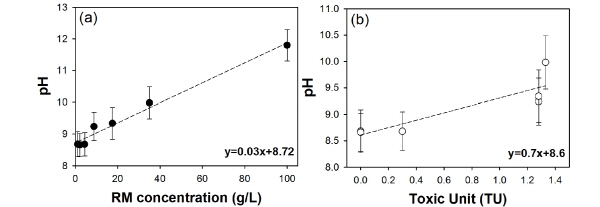
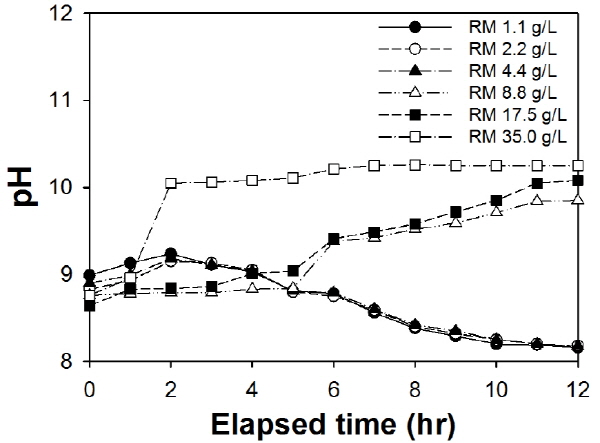
RM is a high-pH alkaline substance (Bhatnagar et al. 2011). From this study, the changes in pH with the concentration of RM were observed for 12 hours. As shown in Fig. 4a, the pH values signi-ficantly increased (R=0.99, R2=0.98, p=0.001) in the range of 8.1–12.3. In addition, the correlation between TU and pH was found to be significant (R=0.88, R2=0.77, p=0.02) (Fig. 4b). As displayed in Fig. 5, the RM concentration above 8.8 g/L resulted in a high pH whereas RM concentrations of less than 4.4 g/L resulted in a low pH. Therefore, RM has the potential to increase the pH in the aqueous phase.
The survival pH range of D. magna was reported to be 6.5–8.5 from the previous study that indicated that D. magna is unable to survive in strong acid (≤3.5) or strong alkali (≥11.0) conditions (Lee et al. 2007). As evident by the test results, a major reason for the increase of TU value could be the increase in pH with the increase in the RM concentration.
4. Conclusions
Both algal growth inhibition test and acute toxicity evaluation test were performed in a lab- scale setting to evaluate the toxic effect of red mud (RM) on freshwater organisms. Results of the algal growth inhibition test revealed that the growth of algae was substantially inhibited in the range of 1.6– 12.5 g/L of the RM solution. In a low-concentration RM solution (<1.6 g/L), the specific growth rate of Pseudokirchneriella subcapitata was a maximum of 1.21 /day, whereas the specific growth rate decreased linearly with the concentration above 1.6 g/L. Results of the acute toxicity evaluation test revealed that the RM solution had a toxic unit (TU) value in the range of 0.0–2.83, which indicates that the toxic level is directly related to the increase in pH with the increase in the RM concentration. There-fore, the use of RM at 4.4 g/L or lower was recommended to comply with the standards for the maximum permissible toxic level (TU<1.0).