


1. Introduction
2. Materials and Methods
2.1 Site description
2.2 Water sampling and analysis
2.3 Sediment sampling and analysis
2.4 Enzyme assay
2.5 Statistical analysis
3. Results
3.1 Water chemistry and microbial activities
3.2 Sediment chemistry and microbial activities
4. Discussion
4.1 Biogeochemical properties of water body and sediment
4.2 Extracellular enzyme activities in water body and sediment
5. Conclusions
1. Introduction
Streams are an important ecosystem because they supply water resources to surrounding areas while simultaneously being influenced by land-use type of stream catchments. Changing in land-use type is one of the most paramount effects of human activities in streams, and its impacts have conti-nuously increased. The recent changes from natural ecosystems (e.g. forests) to agricultural areas (e.g. radish fields and rice paddies) are extensive, because a growing demand for agricultural products over time. According to the FAO (2010), the agricultural area in Asia was 1.06×10⁹ ha in 1961, but this area dramatically increased to 1.94×10⁹ ha in 2009. Therefore, approximately 9×10⁸ ha of a forest area was converted into agricultural fields, such as radish fields and rice paddies, over a half century. Many studies have examined the effects of land-use types on stream ecology (Lenat and Crawford 1994, Wang et al. 1997, Allan et al. 2003, Ahearn et al. 2005, Kim et al. 2015). According to Tong and Chen (2002), land-use types were significantly correlated to biogeochemical variables of streams, such as total nitrogen and total phosphorus. These variables had a positive correlation with agricultural land area, but a negative correlation with forest area (Tong and Chen 2002). Therefore, the destruction of forests and proliferation of agricultural fields may worsen stream health.
While many studies assessed biological properties of streams (Vannote et al. 1980), focusing on organisms such as invertebrates or algae, or physico-chemical properties (Kim et al. 2015), but only few studies have examined the properties of micro-organisms. Microorganisms play an important role in nutrient cycling in water and soil since they mediate decomposition of organic matter and dynamics of nutrients between water body and sediment in stream ecosystems. However, the dynamics of microorganisms in stream ecosystems has not been fully understood yet.
In this study, we selected a stream that is adjacent to three different land-use types in a single and isolated water basin. We then illustrated the biogeochemical properties of stream water body and sediment influence according to the different land-use types. In addition, we examined the extra-cellular enzyme activity in stream ecosystems with diverse surrounding terrestrial ecosystems.
2. Materials and Methods
2.1 Site description
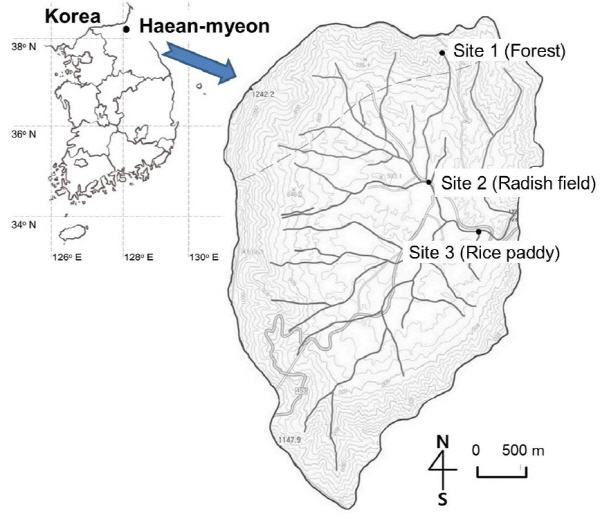
Water and sediment samples were collected at Haean-myeon in the Kangwon Province in South Korea, near the demilitarized zone (38˚17'05" N, 128˚08'34" E). Haean-myeon is located in a moun-tainous basin, surrounded by mountains of varying elevations: Gachil-Bong (1,242 m), Daewoo Mountain (1,179 m), Dosol Mountain (1,148 m) and Daeam Mountain (1,304 m). The elevation of the lowest area in this region is approximately 450 m, and the height of the surrounding mountain areas ranged from 1,000 - 1,300 m. The total area of this basin is approximately 44.7 km2, and land use in this area can be classified into three different types. The first type is a rice paddy, which is usually found in areas where the altitude is less than 500 m. The second type is a radish field for the cultivation of radishes, and it is located at approximately 500 - 750 m in elevation. The third type is a forest, which is mostly found at an altitude of 750 m or above. We collected water and sediment samples at the three sites in the stream with different land-use types and stream orders (Fig. 1(a) and (b)). The first site was located at the mouth of the forest land-use type (38˚18'54" N, 128˚08'26" E), the second site was located at the mouth of radish field land-use type (38˚17'45" N, 128˚08'06" E) and the last site was located at the mouth of the rice paddy land-use type (38˚17'08" N, 128˚08'41" E).
2.2 Water sampling and analysis
Stream water was collected using sterilized poly-ethylene bags with three replications from each site on July 4th, 2012. Dissolved Oxygen (DO), tem-perature and pH were measured at the site using portable equipment. Water samples were transferred to the laboratory on ice and filtered. Two hundred milliliter of water samples were filtered using GF/C filters for suspended solids (SS), total phosphorus (T-P) and total nitrogen (T-N) were determined by DR 2000 spectrophotometry following color reactions with reagents supplied by the HACH Company (Hach Chemical Co., Colorado, USA). Dissolved organic carbon (DOC) was measured by a TOC analyzer (TOC-VCHP, Shimadzu, Kyoto, Japan) after filtration using a 0.45 μm nylon filter. PO42- ion was determined using ion chromatography (Dionex ICS-1100, Thermo Scientific Inc., MA, USA).
2.3 Sediment sampling and analysis
Sediment samples were collected with 3 replicates from each site using a soil corer on July 4th, 2012. After sampling, soil samples were maintained at a temperature of 4°C and analyzed within 5 days. Soil water contents were measured by oven-drying the samples at 105°C for 24 h, and organic matter content was determined by loss-on-ignition (600°C for 24 h). Soil pH was determined by a pH meter after the soil was mixed with distilled water and particles were allowed to settle (soil : water = 1 : 2). Extractable DOC (dissolved organic carbon) concentrations were measured through extraction of soil with distilled water, filtration through a 0.45-μm filter, and then analysis by a TOC analyzer (TOC- VCHP, Shimadzu, Kyoto, Japan). Available phosphorus was determined after Bray P-1 Extraction (Irving and McLaughlin 1990). PO42- ion was determined through ion chromatography (Dionex ICS-1100, Thermo Scientific Inc., MA, USA) after filtration through a 0.2-μm filter.
2.4 Enzyme assay
Methylumbelliferyl (MUF)-substrates were em-ployed as model substrates for enzyme analysis of soil and water. MUF-β-D-glucoside (MUF-G), MUF-N-acetyl-glucosaminide (MUF-N), and MUF- phosphate (MUF-P) were used for ß-glucosidase, N-acetyl-glucosaminidase, and phosphatase, respec-tively. Samples of 1.5 g soil or 1 mL water were amended with 5 mL of substrate (400 μmol). After 60 minutes of incubation at 20°C, fluorescence in the supernatant was determined using a fluorometer with a 450 nm emission and 330 nm excitation wavelengths (FLUOstar, BMG LABTECH, Ortenberg, Germany). For each sample, a calibration curve was prepared using 0 - 200 μmol of MUF-free acid, which was used due to its quenching effects and soil absorption properties (Kang and Freeman 1999)
2.5 Statistical analysis
To evaluate differences among the sites, data was analyzed via one-way ANOVA. For one-way ANOVA, we decided that there were significant differences when P < 0.05. In addition, non- parametric correlation analysis was used to determine the relationship among environmental variables. All analyses were conducted with SPSS 18.0 (SPSS Inc., Chicago, IL, USA).
3. Results
3.1 Water chemistry and microbial activities
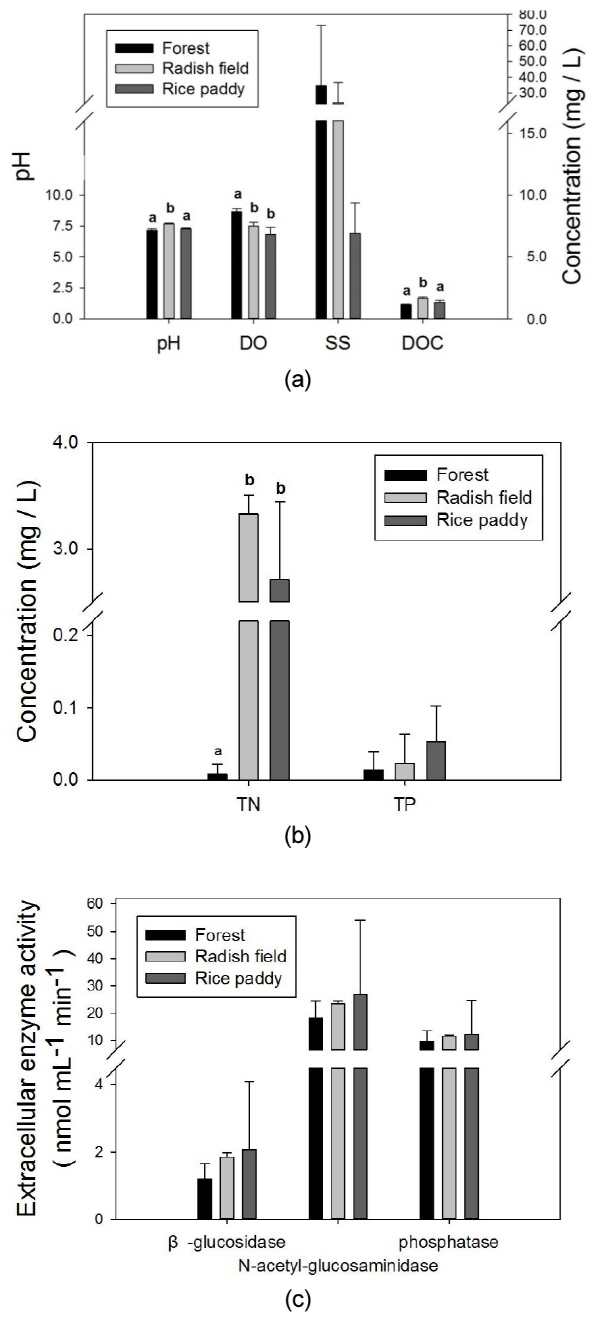
DO was the highest in the stream surrounded by forest, but the lowest in the stream surrounded by rice paddy. pH exhibited the highest values in the stream surrounded by radish field, displaying slightly higher values than neutral. DOC concentrations were recorded from 1.1 to 1.8 mg C L-1, and also exhibited the highest values in the stream surrounded by radish field (Fig. 2 (a)). SS and T-P did not exhibit significant differences among the sites (Figs. 2 (a) and (b)), in contrast, T-N exhibited the lowest values in the stream surrounded by forest (Fig. 2 (b)).
Extracellular enzyme activities (EEA) such as β-glucosidase, N-acetyl-glucosaminidase and phos-phatase, which represent microbial activities, did not exhibit any significant differences among the sites (Fig. 2 (c)). According to the correlation analysis, the microbial activities did not show any relationship with any other measurement factors. However, β-glucosidase exhibited a positive co-rrelation with N-acetyl-glucosaminidase (r = 0.967, P < 0.001) and phosphatase (r = 0.750, P = 0.020).
3.2 Sediment chemistry and microbial activities
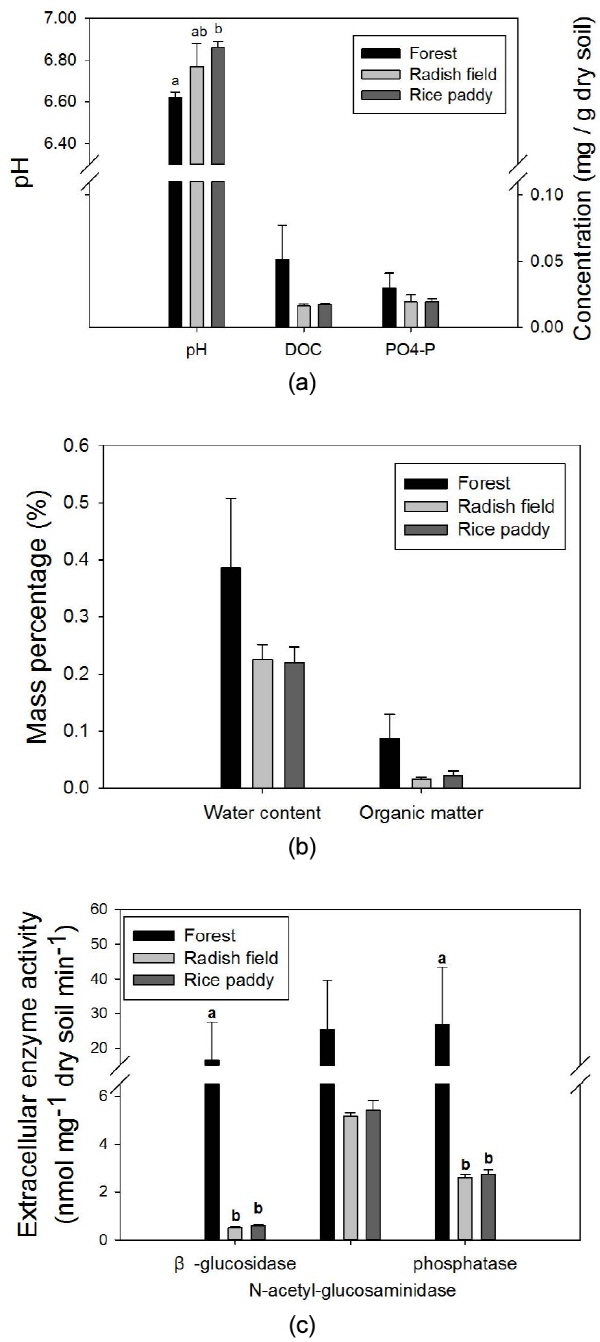
Fig. 3 represents several properties of sediments at the three different study sites. DOC concentrations varied from 0.015 to 0.080 mg C g-1 in dry soils; the highest value was observed in the stream surrounded by forest, and the lowest values were exhibited in the stream surrounded by radish field (Fig. 3 (a)). The concentration of PO42- ion was recorded from 0.014 to 0.041 mg PO42- g-1 in dry soils, with the highest value exhibited in the stream surrounded by forest (Fig. 3 (a)). DOC and PO42- ion showed similar values at all three sites. The pH values increased throughout the stream, with the highest pH value displayed in the stream surrounded by forest and the lowest value displayed in the stream surrounded by rice paddy (Fig. 3 (a)). The values between the stream surrounded by forest and rice paddy showed significant differences. The highest values for organic matter content and enzyme activities were recorded in the stream near the mouth of the forest land type (Figs. 3 (b) and (c)). In particular, β-glucosidase and phosphatase showed significant differences in the stream surrounded by rice paddy.
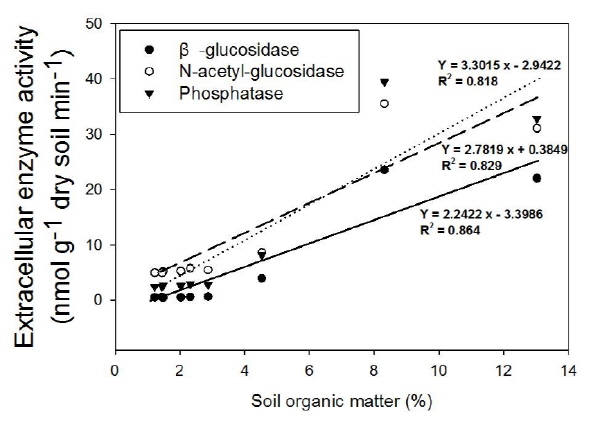
From the correlation analysis, we determined the relationship between microbial activities and various environmental factors. Three enzyme activities showed a positive correlation with soil organic matter content (Fig. 4; r = 0.900, P = 0.001 for β-glucosidase; r = 0.950, P < 0.000 for N-acetyl- glucosaminidase; r = 0.950, P < 0.000 for phos-phatase) and dissolved organic carbon (r = 0.950, P < 0.000 for β-glucosidase; r = 0.750, P = 0.020 for N-acetyl-glucosaminidase; r = 0.750, P = 0.020 for phosphatase). N-acetyl-glucosaminidase and pho-sphatase were negatively correlated with pH (r = - 0.850, P = 0.004 and r = 0.817, P = 0.007, respectively).
4. Discussion
4.1 Biogeochemical properties of water body and sediment
The lowest temperature for water was recorded in the mountainous mouth, but DO exhibited the opposite trend with the highest value displayed in the upper stream; these results agree with previous studies. According to the RCC theory, the upper stream is surrounded by forest, where it experiences shading effects by the canopy; therefore, the temperature of the upper stream exhibited the lowest value (Vannote et al. 1980, Beschta et al. 1987, Johnson and Jones 2000, Johnson 2004). In this research, the lowest temperature and the highest DO were exhibited at the stream surrounded by forest. This result coincided with Henry’s law, in which temperature is inversely proportional to gas solubility. T-N concentration was significantly higher in the stream surrounded by radish field and rice paddy than forest (Fig. 2 (b)). Chen et al. (2011) suggested that increasing in DO concentration may enhance denitrification process. In general, a denitrification rate is negatively correlated with DO concentration. However, if an available carbon substrate is limited, increasing in DO concentration may stimulate decomposition of intact carbon sources. Therefore, DO concentration may be a key factor in determining the carbon-dependent deni-trification (Chen et al. 2011). DO concentration was the highest in the stream surrounded by forest, so this may contribute the lowest T-N concentration in the stream surrounded by forest due to an enhanced denitrification process. Water bodies in streams surrounded by radish field and rice paddy, T-N concentration increased significantly. In a stream water body surrounded by cropland, nitrogen content is much higher than streams surrounded by another type of land, because fertilization provides a lot of nutrient into nearby streams. In addition, the stream surrounded by rice paddy was down-stream, so dilution effects due to an increasing in flow rate may decrease the concentration of SS and T-N in that area (Farthing and Toetz 2000).
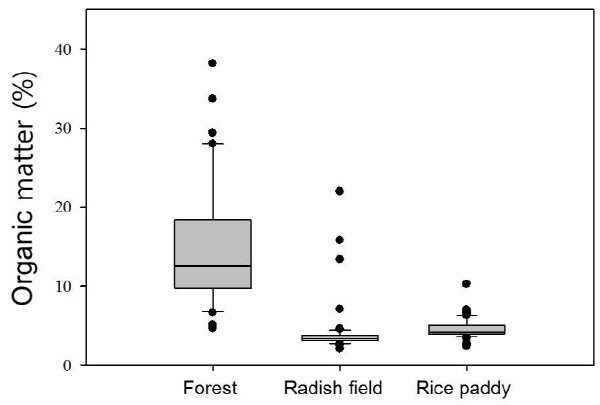
When we compared the sediment organic matter content with values from terrestrial ecosystems, organic matter content in soils from each surrounding land-use type showed similar results for sediment values, with the highest values recorded from the forest soils (Fig. 5). Organic matter in sediments was influenced by soils from surrounding terrestrial areas rather than the water body itself. According to the RCC, important factors for water bodies of streams are the connection with the upper stream and the velocity of stream water flow (Vannote et al. 1980). In addition, the surrounding land-use type could be an important factor for sediment properties as well.
4.2 Extracellular enzyme activities in water body and sediment
All three extracellular enzyme activities in soils were higher in the stream surrounded by forest (Figs. 2 (c) and 3(c)) than the other streams. According to Chen et al. (2011), DO concentration had a positive correlation with extracellular enzyme activity. In streams surrounded by forests, a large amount of leaf litters and small branches of tree is introduced to streams. These carbon substances are decomposed by extracellular enzyme, and transformed into a DOC. DOC in water body is washed out rapidly, but some portion of DOC is accumulated in stream sediment.
Therefore DOC concentration in the sediment in forest stream was particularly higher than other sediments or water bodies. As previously discussed, the organic matter in soils exhibited the highest values in the stream surrounded by forest. Because microorganisms use organic matter as their energy and carbon sources, many studies have examined the relationship between microbial properties, such as activity, community structure and abundance, and the substrate concentration and/or composition. However, the relationship between these two factors is not fully understood, especially in soils (Söderström et al. 1983,Henriksen and Breland 1999). Kaur et al. (2000) ascertained that soil organic matter originated from plant stimulated microbial activities (Kaur et al. 2000). In addition, Lipson et al. (2000) revealed that carbon availability was an important factor for regulating microbial biomass (Lipson et al. 2000). Their results suggested that microbial biomass corresponded with water-soluble organic C. In our experiment, soil organic matter also showed a positive relationship with microbial activities, so it appears that microorganisms were stimulated by abundant substrate supply.
5. Conclusions
Many previous studies of stream ecology focused on the water body or sediments but missed the connection with surrounding terrestrial ecosystems. Here, we examined the relationship between the land-use type and water and soil properties. Not only were chemical properties analyzed, but micro-bial activities were examined as well. From the results of this experiment, we determined that soil properties such as soil organic matter content were related to the surrounding land-use type. Extracellular enzyme activities in soils were also influenced by soil organic matter content; in fact, the highest microbial values exhibited were in the stream surro-unded by forest. In addition, the nitrogen content in the water body increased as it passed through radish field. This increase could be caused by nitrogen fertilizer, which is used to promote productivity on these lands. The studies that consider the connection between land-use type and stream properties are becoming increasingly important as civilization expands and changes in land-use types occur. However, we only examined one stream and did not consider seasonal variations. Therefore, further study should examine more streams and consider seasonal variations.